
McKinsey found a three-person team completing in four days what once took ten people a month. But the 10x number misses the real story: as AI removes the coding bottleneck, the constraint shifts to product clarity, team structure, and knowing which code is safe to ship.


The Numbers Look Impressive. Then Reality Sets In
McKinsey documented a three-person team completing a website redesign in four days. A traditional team of ten took four weeks. That’s 10x.
Executives like this number. The problem is it doesn’t mean much on its own. Individual productivity improvements don’t move revenue or products closer to market.
The real shift happens when an organisation uses AI to redesign the entire workflow. Not handing developers better tools and hoping. Actually rethinking how work flows from conception to production.
The Constraint Isn’t Code Anymore
As AI accelerates coding, the bottleneck shifts. Code isn’t the limiting factor. Deciding what to build is.
That’s a hard mindset change. We optimised for coding velocity for years. Now the constraint is product clarity. Strategic direction. The ability to specify a problem clearly.
And then there are the cascade constraints. Code review. Security evaluation. Deployment pipelines that weren’t designed for the pace at which AI generates working code. Traditional eight or nine-person teams, built with specialised frontend developers, backend developers, and QA engineers, can’t coordinate fast enough to keep up.
Teams Shrink, Skills Shift
Teams are now three or four people instead of eight or nine. Roles are more generalist. You need “definers” (people who can break down problems and specify what to build) and “builders” (people who can direct AI-powered development, review output, own quality).
The narrow specialisations that commanded premium salaries are fading. Deep language syntax expertise, the thing developers spent years mastering, is something AI does now.
What matters instead:
Systems thinking and architectural design
Problem decomposition: breaking complex work into tasks an AI can execute
Strategic judgment about product direction
Code review and quality assurance through human oversight
Risk evaluation and decision-making
Everyone on the team needs to think like a tech lead earlier in their career. Skills that used to take five or six years are becoming table stakes by year two or three.
Where Humans Actually Matter
As AI got more capable, human judgment became harder to replace, not easier. AI generates the code. Humans own the strategy.
Which direction matters? AI can build many solutions fast. Choosing the right one is human judgment.
Will anyone actually want this? Product-market fit isn’t something AI figures out. That’s validation work.
Is this safe and resilient? AI-generated code is usually more verbose and less secure than code written by hand. Quality assurance and risk management are still human responsibilities.
Is this genuinely new? Pressure-testing new concepts, validating whether you’ve discovered something worth building, requires human insight.
The Development Cycle Itself Changes
AI isn’t just making the existing process faster. It changes which steps happen and when.
Test-driven development, which was hard to scale, becomes practical. Risk and resilience evaluation happens earlier. Fewer human review steps are required. The approach varies by context: greenfield builds move differently from modernisation projects or technical debt paydown.
Full Autonomy Isn’t Close
Despite the noise, full enterprise autonomy in software development is still years away. AI handles narrow, well-defined problems: greenfield builds with clear specs, modernisation projects with obvious targets. Widespread autodeployment stays behind careful gates due to security and quality concerns, even when it’s technically possible.
Most organisations are in the middle: getting real velocity gains from AI-assisted development while managing bottlenecks in decision-making, security, and scaling.
What Matters Now
The organisations that pull ahead are treating AI as a signal to redesign their entire development process, not just a faster code generator. Rethinking team structure. Redefining which skills matter. Shifting where humans focus their work.
The constraint moved. The winners are the ones who noticed.
Why We Built Norma by Quality Clouds
At Quality Clouds, we recognised early on that to safely harness the power of AI-powered software development, organisations need a new layer of control — an AI Code Governance layer. That is exactly why we built Norma by Quality Clouds.
Norma by Quality Clouds is designed to govern both AI-generated and human-written code before it ever reaches production, acting as your safeguard in this new era of rapid development. We built it to close the governance gap with:
Real-Time, AI-Aware Validation: Through our LivecheckAI and MCP integrations, Norma injects governance, security, and platform-aware rules directly into IDEs (like Cursor) and tools (like Claude Code) at the exact moment of generation.
Automated Certification and Quality Gates: Norma enforces enterprise-grade standards automatically, ensuring that no technical debt, security vulnerabilities, or non-compliant configurations make it past your pipeline.
A Complete Audit Trail: As compliance becomes more critical, Norma provides risk teams with a defensible, comprehensive record of every scaz gzn, decision, and policy applied to your AI-generated code.
Rewriting the Rules with Confidence The job of building software has been turned on its head. It’s no longer about deep experience in specific syntax; it’s about decomposing problems, parsing work to agents, and inspecting the results. By integrating Norma by Quality Clouds into your lifecycle, you establish “One Standard. Everywhere.” We empower your teams to experiment with innovative ideas and ship at unprecedented speeds, with the absolute confidence that every line of code is safe, compliant, and enterprise-ready.

Mariona Valero
Lead Marketing Manager
Related articles
Stay ahead of the curve
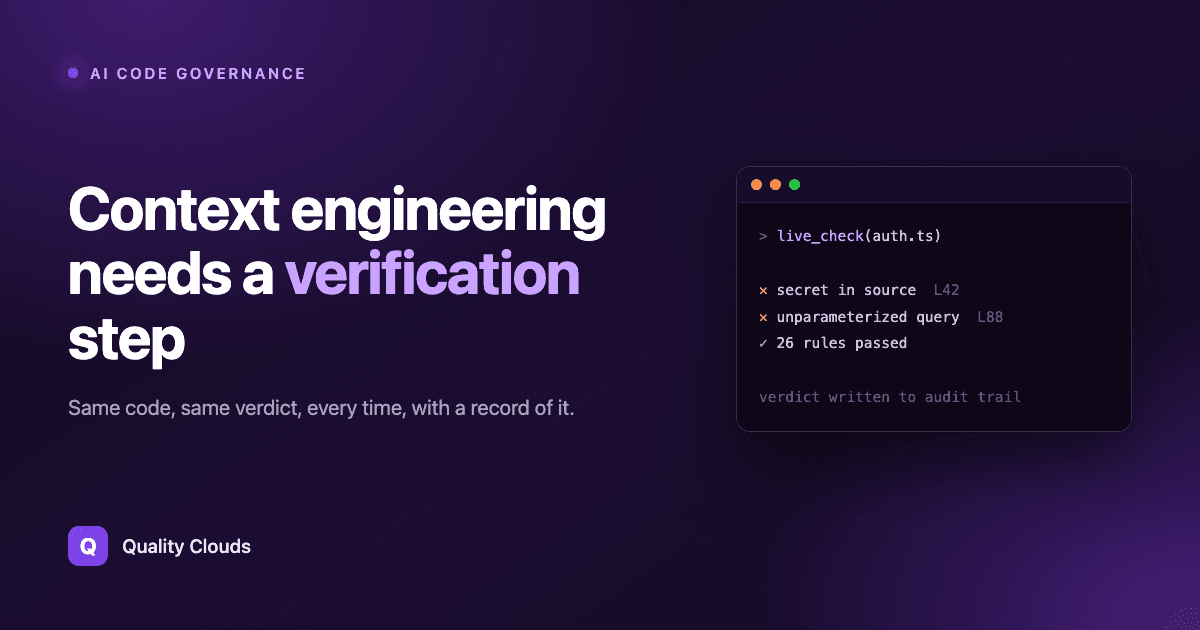
Context engineering needs a verification step

Albert Franquesa
5 min read
Better context raises the odds that AI-generated code is good. It does not tell you whether any particular file is. Here is where the check goes.

Claudeforce makes Salesforce headless. Governance has to move with it

Taher Dohadwala
6 min read
Salesforce is going headless. Learn what changes and how to govern what the agents build

Your Vibe Coded App Probably Has a Security Hole. Here Is How to Find It.
Albert Franquesa
10 min read
The five security holes AI keeps writing into vibe coded apps, and how to find yours in about two hours.