
As AI coding tools like GitHub Copilot and Agentforce multiply output tenfold, manual reviews have become statistically irrelevant. This guide defines AI code governance: the automated policies and enforcement mechanisms required to stop "governance debt" from accumulating in production



A Practical Guide for Enterprise Teams
If your team is using AI coding tools — and at this point, most are — you've probably noticed that the conversation around governance hasn't kept pace. Everyone's talking about how fast AI can generate code. Fewer people are talking about what happens to that code once it's running in production.
That's the gap AI code governance is designed to fill.
This guide breaks down what AI code governance actually means, why it matters for enterprise platform teams, and how to implement it across the three environments where AI-generated code is already accumulating: ServiceNow, Salesforce, and AI-native development platforms like Lovable, Cursor, and Replit.
The Problem That Preceded the Term
Before we define AI code governance, let's be honest about what prompted it.
AI coding tools have gone mainstream fast. GitHub Copilot crossed one million paid users within months of launch. Salesforce's Agentforce and ServiceNow's Now Assist are now embedded directly in the platforms your developers use every day. A new generation of AI-native builders — Lovable, Cursor, Replit — can generate complete application prototypes from a single prompt.
Gartner estimates that by 2028, 75% of enterprise software engineers will use AI coding assistants daily, up from fewer than 10% in 2023. McKinsey's research puts developer productivity gains from AI tools at 20–45% depending on task type. These are genuine tailwinds.
Here's the problem.
A Harvard Business School study found that developers accept 94% of AI-generated code suggestions. The same research found that nearly 45% of those suggestions contain security or maintainability flaws. When you multiply high acceptance rates by high error rates — at speed, at scale — you aren't building software faster. You're accumulating what we call governance debt: business logic that has bypassed your organizational policy and is sitting quietly in production, waiting to cause a problem.
94% acceptance rate. ~45% flaw rate.
Remove human review from the equation and you're compounding risk at the speed of AI.
That's the problem AI code governance exists to solve.
So What Is AI Code Governance, Exactly?
AI code governance is the set of policies, controls, and automated enforcement mechanisms that ensure AI-generated code meets your organization's standards before it reaches production.
The key word is automated. Manual review cannot scale to match AI output. If your team was already struggling to review human-generated code — and most enterprise teams were — adding an AI layer that multiplies output tenfold makes manual review statistically irrelevant. You need governance that runs at the same speed as generation.
AI code governance covers four core areas:
1. Policy Definition
What are the rules your code must follow? This means security policies (no hardcoded credentials, no unauthenticated API exposure), platform-specific best practices (ServiceNow upgrade readiness, Salesforce governor limits), compliance requirements (data residency, access control), and your own internal standards. These policies need to be codified as machine-readable rules — not just wiki pages.
2. Automated Scanning and Detection
Your governance tooling needs to scan every unit of code — whether written by a human, generated by an AI assistant, or assembled in a low-code studio — and flag anything that violates your policies. This should happen continuously, not only at release gates.
3. Pre-Production Enforcement
The best time to catch a governance issue is before it goes live. Shifting governance left — into the IDE, the platform studio, or the CI/CD pipeline — means violations are surfaced when they're cheap and easy to fix, not after they've accumulated downstream dependencies.
4. Visibility and Reporting
Governance without visibility isn't governance. Platform owners and engineering leads need a clear, real-time view of their risk posture: what's in production, what's newly created, and what's trending in the wrong direction. That visibility is what enables informed decisions about technical remediation and delivery risk.
Why Traditional Governance Breaks Down with AI
Most enterprise governance frameworks were designed for a world where humans wrote every line of code. That world is over.
Legacy governance approaches typically rely on periodic manual code reviews, pre-release security scans, annual audit cycles, or tribal knowledge held by senior engineers. Each of these has a common flaw: they're episodic. They catch problems at specific moments in time rather than continuously.
AI changes the math fundamentally: When a developer uses Copilot inside a ServiceNow studio, they might accept 50 suggestions in an afternoon. When a business analyst uses Lovable or Claude to prototype a customer-facing workflow, they can generate thousands of lines of code without writing a single one. When a Salesforce developer uses AI to scaffold an Apex class, the speed of creation outpaces any retrospective review process.
The result is what we've covered in depth in our post on Governance Debt: The Hidden Interest Rate of the AI-Native SDLC: a compounding liability where flawed logic accrues in your platforms faster than any team can audit it. The interest compounds silently — until an outage, a breach, or a compliance audit surfaces it all at once.
Where AI Code Governance Applies: The Three Environments
AI code governance isn't just a software engineering concern. It's a platform governance concern — and it applies wherever AI is being used to create business logic. For most enterprise teams, that means three environments.
ServiceNow
ServiceNow is the operational backbone for IT, HR, and customer service workflows at thousands of enterprises. Now Assist — ServiceNow's native AI capability — can generate flows, scripts, and catalog items directly within the platform. Developer teams are also layering external AI tools on top of the ServiceNow studio.
The governance risks here are significant. A misconfigured flow can bypass approval chains. A poorly written script can expose sensitive data. A workflow that violates upgrade readiness guidelines can block your next platform release. ServiceNow governance needs to be native — catching issues inside the platform, not just scanning exported code after the fact.
One thing worth calling out specifically for ServiceNow teams: Quality Clouds lets you build your own governance rules in plain English. You write a policy statement — say, "flag any Business Rule that references a hardcoded email address" — and the AI Rule Builder converts it into an enforceable scan definition instantly. No scripting, no developer time, no delay between policy intent and policy enforcement.
Salesforce
Salesforce governance has always been a challenge because of the platform's flexibility. Apex classes, Flows, triggers, permission sets — there are dozens of ways to create logic, and dozens of ways that logic can go wrong. Agentforce adds AI generation on top of that complexity.
Specific risks in Salesforce include data leakage through misconfigured sharing rules, governor limit violations that cause production failures, and security gaps in Apex code that bypass Salesforce's own security model. AI generation amplifies each of these risks, because AI tools don't inherently understand your org's specific data model, security model, or compliance requirements.
As with ServiceNow, Salesforce teams can define their own rules in natural language using the AI Rule Builder. Your architects and compliance leads can codify organizational policy directly — without needing to translate requirements into code first. The rule is live and enforced across every scan from the moment it's created.
AI-Native Development Platforms
This is the newest — and fastest-growing — governance surface. Platforms like Lovable, Cursor, and Replit enable a new class of builder: business analysts, product managers, and citizen developers who can generate complete applications without deep engineering expertise.
That's a genuine productivity unlock. It's also a governance gap that most enterprise teams haven't addressed yet.
Code generated in Lovable can end up connected to production APIs. Applications built in Cursor or Replit can be deployed to cloud environments where they interact with sensitive data. Without governance on this layer, enterprise teams are effectively allowing unreviewed code to enter their ecosystem through a side door.
Governing ServiceNow and Salesforce while leaving AI-native platforms ungoverned is like locking the front door and leaving the back door open.
A Smarter Approach: Govern at Generation, Not After
For teams that have moved beyond detection and into prevention, there's a more efficient approach available: constrained generation via MCP (Model Context Protocol).
Here's the idea. Instead of letting an AI tool generate code freely and then scanning it for violations afterwards, you inject your governance rules — naming conventions, security policies, platform standards — directly into the AI's context window at the moment it generates code. The result is that the AI produces compliant code from the first token, rather than producing non-compliant code that then needs to be caught, flagged, and corrected.
This matters beyond quality. Every correction loop costs tokens. When an AI assistant generates a suggestion, you reject it for a policy violation, and it regenerates — that's two API calls, not one. At scale, across a development team, those correction cycles add up to real cost. Constraining the LLM to your governance policies at generation time eliminates that loop entirely. You get compliant code, and you get it cheaper.
Quality Clouds supports this through an MCP Server integration with Now Assist Builder, and it's the direction we're extending to AI-native environments as well. If you're thinking about AI governance architecturally — not just as a detection layer but as a control layer — this is where the most leverage is.
Governing AI-native platforms like Lovable, Cursor, or Replit?
Quality Clouds' Modern Dev Platform (MDP) governance is available as a managed evaluation
What AI Code Governance Looks Like in Practice
Let's move from concept to what this actually looks like day to day.
For a platform owner responsible for ServiceNow governance, AI code governance means: every deployment — created by a developer, a partner, or an AI assistant — is scanned against a ruleset before it reaches production. Critical violations are blocked. Warning-level issues are surfaced to the developer at the point of creation, with remediation guidance. A dashboard gives you a real-time view of your instance's governance posture, so you're never walking into an audit blind.
For a Salesforce admin or architect, it means: Apex code is checked for security anti-patterns, Flows are validated against your data model and access controls, and governor limit risks are flagged before they cause production failures. When AI tools generate suggestions, those suggestions are held to the same policy standard as human-written code.
For a team using AI-native tools like Lovable or Cursor, it means: there's a governance checkpoint before AI-generated applications connect to enterprise systems. Code review doesn't disappear — it gets automated and embedded into the workflow rather than piling up at the end of it.
In all three cases, the principle is the same: governance at the speed of generation. Not slower.
The Connection to Governance Debt
If you haven't read our piece on Governance Debt: The Hidden Interest Rate of the AI-Native SDLC, it's worth five minutes of your time. The core argument is this: unreviewed, policy-violating code accumulates in your platforms like financial debt — and like financial debt, it compounds.
Every week you don't have automated governance in place, the debt grows. When it eventually surfaces — through an outage, a security incident, or a compliance audit — the remediation cost is an order of magnitude higher than it would have been at the point of creation.
AI code governance is how you stop the debt from accumulating in the first place. It's not a remediation strategy. It's a prevention strategy.
How to Get Started
The good news is that you don't need a six-month implementation project to start governing AI-generated code. Here's a practical starting sequence:
Get visibility first. You can't govern what you can't see. Run a scan of your ServiceNow or Salesforce instance to understand the current state of your code base — what's there, what's policy-compliant, and where risk is concentrated. Most enterprise teams are surprised by what they find.
Define your policy baseline. What are the non-negotiable rules for your platforms? Security requirements, compliance obligations, platform-specific best practices — these need to be codified as enforceable rules, not just guidelines in a document.
Shift enforcement left. Once you have a baseline, implement it at the point of creation: in the IDE, in the platform studio, in the CI/CD pipeline. The goal is to catch violations before they're deployed, not after.
Extend to AI-native environments. If your teams are using Lovable, Cursor, Replit, or similar tools, bring them into scope. Treat AI-native code with the same governance standards you apply to your core platforms.
Build a feedback loop. Governance policies need to evolve as your platforms, compliance requirements, and AI tooling evolve. Set a regular cadence for reviewing and updating your ruleset.
Start With Visibility
The most common thing we hear from enterprise platform teams when they first scan their instances is: "I had no idea this was in there."
That's the nature of governance debt. It accumulates silently, in the background, while everyone is focused on shipping the next feature. AI accelerates the accumulation. The only way to get ahead of it is automated, continuous governance — applied consistently across ServiceNow, Salesforce, and every AI-native environment your teams are using.
Quality Clouds governs AI-generated and human-generated code across all three. You can see exactly where your governance risk sits today — before it becomes a problem.
Start your free Quality Clouds account
No implementation project. No professional services engagement. Connect your ServiceNow, Salesforce, or AI-native environment and run your first governance scan in minutes.

Albert Franquesa
Co-Founder & CSO, Quality Clouds
Related articles
Stay ahead of the curve
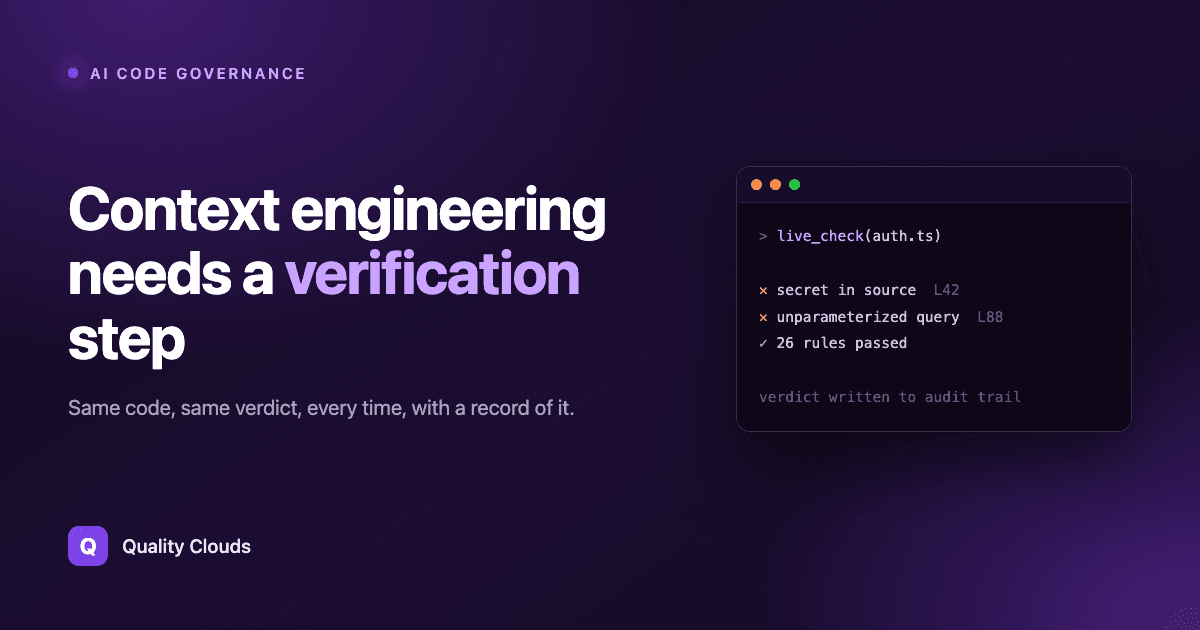
Context engineering needs a verification step
Albert Franquesa
5 min read
Better context raises the odds that AI-generated code is good. It does not tell you whether any particular file is. Here is where the check goes.

Claudeforce makes Salesforce headless. Governance has to move with it

Taher Dohadwala
6 min read
Salesforce is going headless. Learn what changes and how to govern what the agents build

Your Vibe Coded App Probably Has a Security Hole. Here Is How to Find It.
Albert Franquesa
10 min read
The five security holes AI keeps writing into vibe coded apps, and how to find yours in about two hours.