
Production readiness has always been contextual — but AI code generation has made this more urgent. It is not just about security or defect counts. It means: does this code comply with the guardrails your organisation has chosen to enforce?



The Definition Everyone Uses — and Why It Falls Short
Ask any engineering team what “production ready” means and you will get roughly the same answer. No critical security vulnerabilities. Acceptable performance under load. A defect count below some agreed threshold. Tests passing. Deployment pipeline green.
These are reasonable criteria. But they are not sufficient. They never were — and AI code generation has made the gap impossible to ignore.
Here is the problem: a piece of code can pass every standard quality gate and still be wrong for your organisation. It can be secure by OWASP standards and still violate your internal data handling policy. It can perform well under load and still bypass the approval workflow your compliance team requires. It can have zero defects and still use a deprecated API pattern your platform team banned six months ago.
Production readiness is not a universal standard. It is a policy decision. And in the age of AI code generation, that distinction matters more than ever.
What AI Code Generation Changes
AI coding tools — Lovable, Replit, Cursor, Claude Code — are genuinely useful. They compress development time. They help non-engineers build working applications. They reduce the cost of prototyping. I am not arguing against them.
But they introduce a dynamic that most organisations have not yet addressed: anyone can now generate and ship code. Not just senior developers who know the internal rulebook. Business analysts. Product managers. Operations teams. People who have never read your platform governance policy — because until recently, they never needed to.
The volume of code reaching production review has increased dramatically. The proportion of that code written by people who deeply understand your organisation’s standards has not kept pace. And AI tools, by design, optimise for working code — not for compliant code. They do not know which of your ServiceNow tables are restricted. They do not know that your organisation mandates specific security scoping on every record query. They do not know that your Salesforce org prohibits hardcoded IDs.
They produce code that works. Whether it meets your standards is a separate question entirely.
Production Readiness Is a Policy Decision
This is the reframe that matters: production readiness is not a checklist. It is a living set of rules — rules that reflect your organisation’s risk tolerance, regulatory environment, platform architecture, and operational standards.
At a regulated financial services firm, production ready means passing a set of controls that would not apply at a retail e-commerce company. At a healthcare provider operating under HIPAA, it means something different again. At a ServiceNow-heavy enterprise, the definition includes platform-specific standards — governor limits, ACL patterns, update set hygiene — that have no equivalent in a Salesforce environment.
Every company defines production readiness differently. And that is correct. The problem is not that definitions vary. The problem is that most organisations have not made their definition explicit, automated, or enforceable.
When code was written slowly, by professional developers, in pull request workflows with senior reviewers, the implicit knowledge held. Engineers knew the standards because they had been there long enough to absorb them. Review processes caught deviations.
AI code generation breaks that model. The code arrives faster, from more sources, and often with less context about the organisation’s specific requirements. Implicit knowledge is not enough. The guardrails need to be explicit — and they need to be enforced automatically.
What Guardrails Actually Mean in Practice
When I use the word guardrails, I mean something specific. Not a general sense of “good practices”. Not a static document that lives in a wiki and gets ignored. I mean rules that are:
Defined by your organisation — not by a vendor’s default policy
Expressed as code — so they can be evaluated automatically, at scale
Applied before production — as a hard stop, not a suggestion
Maintained as your platform evolves — because standards change, and your governance needs to change with them
This is what AI Code Governance means in practice. It is not a synonym for security scanning. It is not static analysis. It is the layer between code generation and production deployment that asks: does this code meet the specific standards this organisation has decided to enforce?
In a ServiceNow environment, that might mean: no direct table queries without ACL validation, no hardcoded user references, no Business Rules without appropriate conditions, no scripts that bypass the platform’s built-in logging. In a Salesforce org, it might mean: no SOQL queries in loops, no hardcoded record IDs, mandatory sharing model adherence, specific API version controls.
In an AI-native development environment — where a business team used Lovable to build a customer portal, or a developer used Claude Code to generate an integration — it means: the same standards apply, regardless of how the code was written.
WHITEPAPER
Production readiness is a policy decision
AI tools optimize for working code—not compliant code. Get the whitepaper to learn how to turn your implicit engineering standards into automated, unbreakable production guardrails
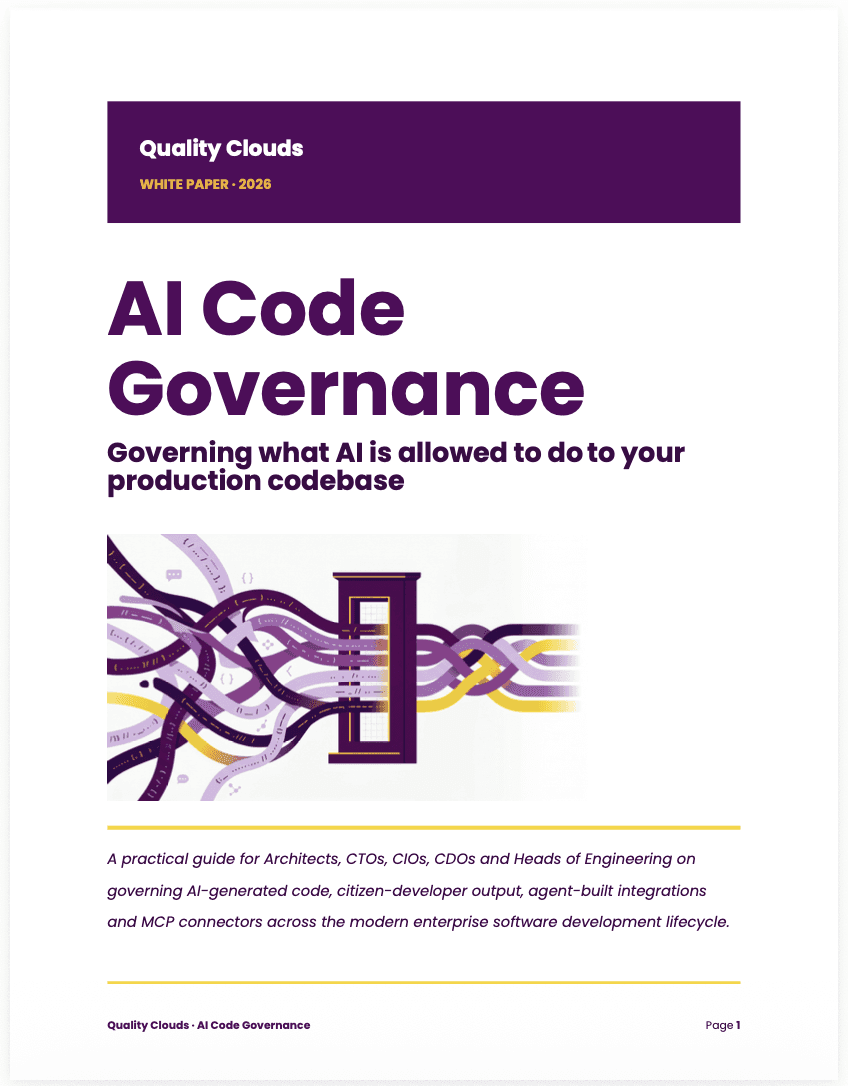
The Guardrails Are Yours to Define
This is the point that organisations sometimes miss. AI Code Governance tools do not tell you what your standards should be. That is your decision — and it should be, because only you know your regulatory obligations, your platform architecture, your operational risk tolerance, and your team’s capabilities.
What governance tooling does is make it possible to enforce whatever standards you choose, automatically, at the speed AI code generation requires.
At Quality Clouds, we work with enterprise organisations across ServiceNow, Salesforce, and AI-native development platforms. The production readiness standards we help enforce are different at every client. A global bank running 18 ServiceNow instances across multiple business units has different standards from a European logistics company with a single Salesforce org. What they share is the need to make those standards explicit and enforceable — not rely on senior engineers to catch deviations in manual review.
We give platform teams the ability to define their own rules — using our Rule Builder — and enforce them automatically through Quality Gates that act as hard stops before deployment. LiveCheckAI surfaces violations in real time, in the developer’s environment, before the code ever reaches a review queue.
The goal is not to slow down development. The goal is to make it possible to move fast without accumulating the kind of technical and compliance debt that becomes a crisis twelve months later.
Start With the Question, Not the Tool
If your organisation is using AI coding tools — and most are, whether or not leadership is aware of it — the most important question to ask is not “which governance tool should we buy?” It is: “what does production ready actually mean for us, and are we enforcing it?”
That question has a different answer at every company. But the organisations that answer it clearly, and build the enforcement layer to match, are the ones that will be able to use AI code generation at scale — without the production incidents, the compliance failures, and the emergency remediation sprints that follow from treating production readiness as someone else’s problem.
Production-Ready AI Code does not happen by accident. It happens because an organisation decided what that means — and built the guardrails to enforce it.
Ship AI code at scale. Without the technical debt
See it in action

Albert Franquesa
Co-Founder & CSO, Quality Clouds
Related articles
Stay ahead of the curve

What Is AI Code Governance?
Albert Franquesa
10 min read
The goal is trust: know what goes into production and be able to prove it. The six guarantees AI code governance has to deliver.

How do I build the (with AI)? Let me count the ways

Ignacio Sales
11 min read
Seven ways to build on ServiceNow with AI, three places the code lands, and where Quality Clouds for ServiceNow checks each one.

ServiceNow and GitHub: how to govern pull requests when your apps move to source control

Taher Dohadwala
6 min read
ServiceNow source control works per application and the diff is XML. Here's what that means for pull requests, update sets, and where to put the gate.