
While AI coding tools have vastly accelerated software development cycles, they often introduce silent vulnerabilities, compliance gaps, and architectural drift. This article outlines a systematic approach to AI Code Governance, detailing the recurring, high-frequency mistakes AI models make and offering a five-step blueprint to build an automated, continuous production-readiness workflow that makes development speed safe


The Speed Problem Nobody Is Talking About
AI coding tools — Cursor, Lovable, Replit, GitHub Copilot, Claude Code, Now Assist, Agentforce — have fundamentally changed how fast code gets written. Developers produce working prototypes in hours. Business teams ship workflows and automations without writing a line of code themselves.
That speed is real. The risk attached to it is equally real.
The question every CTO, CISO, and software architect needs to answer before the next deployment is simple: Is your AI code actually safe to ship? Not in theory. Not according to the tool that generated it. In practice — against your organisation's security policies, compliance obligations, and technical standards.
This article walks through how to answer that question systematically, and where AI Code Governance fits into a production deployment workflow.
Why AI-Generated Code Fails Silently
AI tools optimise for functional correctness. They produce code that works — in the environment the model was trained on, against the patterns it has seen most often, under assumptions that may not match your stack or your organisation's configuration.
The failures that matter most in enterprise environments are not syntax errors. They are the things AI models cannot know:
Your organisation's internal security hardening rules
Deprecated APIs in your current platform or framework version
Custom naming conventions that govern downstream integrations
Compliance constraints specific to your industry or jurisdiction
Performance thresholds defined by your infrastructure team
AI tools generate to a generalised standard. Your production environment operates to a specific one. The gap between those two is where incidents happen.
The Recurring Mistakes AI Tools Make
Beyond the organisation-specific gaps above, there is a second, more predictable category of failure: the small set of coding mistakes AI tools make again and again, regardless of which model or platform produced them. These are not failures of context — they are patterns baked into how these tools generate code. They look correct, they compile, they pass a casual review, and they fail in production.
A few that appear constantly in AI-scaffolded code:
Network calls without a timeout. AI tools routinely emit
fetch()calls and Supabase client operations with noAbortController, timeout, or signal parameter. If the downstream service is slow or unreachable, the request hangs indefinitely and the UI freezes on a loading spinner.Missing try/catch blocks. Async operations and external calls are generated without error handling, so a single rejected promise takes down a flow that should have degraded gracefully.
Unsanitised URLs in React. AI tools frequently pass user-controlled or external URLs straight into
hrefandsrcattributes without asanitizeUrlstep, opening the door tojavascript:URI injection and similar client-side issues.
These are exactly the mistakes that slip past a human reviewer skimming AI output, because the code looks idiomatic. The Norma by Quality Clouds ships with specific rules tuned to these recurring patterns — each one a precise check, with the offending line, the impact, an estimated time to fix, and the exact location in the codebase. The point is not to catch exotic vulnerabilities; it is to catch the high-frequency, high-impact mistakes these tools make every day, before they reach production.
Your AI Code Works. But Is It Safe to Ship?
What a Production Readiness Check Actually Covers
Before any AI-generated code reaches a production environment, it needs to pass four layers of scrutiny.
1. Security
Hard-coded credentials, insecure API calls, missing input validation, and overly permissive access controls all appear in AI-generated code. A security scan must check for these against your organisation's defined policies — not a generic ruleset.
2. Platform and Framework Compliance
Platforms and frameworks evolve rapidly. A coding pattern that was correct eighteen months ago may now use a deprecated method, conflict with a recent update, or violate a vendor-defined best practice. AI models trained on older data produce older patterns. Compliance checks catch these before they create production debt.
3. Regulatory Obligations
Regulated industries carry additional requirements. Code that handles financial transactions must align with DORA controls. Code that processes personal data must respect data minimisation principles under GDPR. Code deployed in financial services must satisfy FCA operational resilience expectations. These requirements do not appear in an AI model's output unless explicitly enforced by a governance layer sitting above the generation step.
4. Organisational Standards
Every enterprise has internal rules: architectural decisions, naming conventions, approved libraries, banned patterns. AI tools have no visibility into them. Governance tooling encodes them as enforceable rules applied consistently at every scan.
How to Build a Safe Shipping Process for AI Code
Step 1 — Define Your Standards as Enforceable Rules
Governance starts with codified standards. Quality Clouds lets you calibrate its rules and policies to your organisation's security, platform, and compliance requirements, turning them into enforceable checks. Rules that live in a wiki or a PDF enforce nothing. Rules encoded in a governance engine run automatically on every scan.
You do not start from a blank page. Norma ships with a library of rules covering the recurring AI-generated mistakes described above — missing timeouts, absent error handling, unsanitised URLs, and more — so the common failures are caught from day one. From there, you calibrate those rules and add your organisation's specific standards on top.
Step 2 — Scan Before Every Promotion
Every promotion from development to test, and from test to production, must trigger a scan. Quality Clouds' Full Scan analyses every element of the codebase, not just the delta from the last commit. AI-generated code often introduces dependencies and side effects that manual delta reviews miss.
Step 3 — Enforce Quality Gates
Quality Gates block promotion when a scan breaches defined thresholds. Set gates for critical security findings, deprecated API usage, and compliance violations. A gate that raises a warning is not a gate — it is a suggestion. Promotion must stop on critical findings, with a documented exception process for justified overrides.
Step 4 — Monitor Continuously in Production
Shipping safely is not a one-time event. Vendors release updates. Regulatory guidance changes. New vulnerabilities are identified in patterns previously considered safe. LivecheckAI provides continuous monitoring of production code, alerting when previously compliant code drifts out of conformance due to environmental changes. Governance does not end at deployment.
Step 5 — Close the Feedback Loop to Developers
Governance tooling that only produces reports changes nothing. The output of every scan must reach the developer inside their workflow, before they submit for promotion. When Quality Clouds surfaces a finding directly in the development environment, the developer understands what the rule requires and can correct the code immediately. This shortens remediation cycles and builds institutional knowledge over time.
The Role of AI Code Governance Across Platforms
AI Code Governance is not a single-platform concern. A typical enterprise runs a growing set of AI coding tools and agentic systems generating code across many stacks at once. Each tool has its own generation patterns. Each stack has its own standards. A governance layer must operate across all of them from a single policy framework.
Quality Clouds delivers AI Code Governance as a platform- and technology-agnostic layer. Norma draws on eight years of governance experience earned on demanding enterprise platforms such as ServiceNow and Salesforce — that depth informs its rules — but Norma itself governs AI-generated code wherever it is produced, across any stack. Rules defined once apply regardless of environment. Teams working with Cursor, GitHub Copilot, Claude Code, or any other AI development tool pass through the same governance checkpoints. The AI tool used to generate the code is irrelevant. The governance standard is constant.
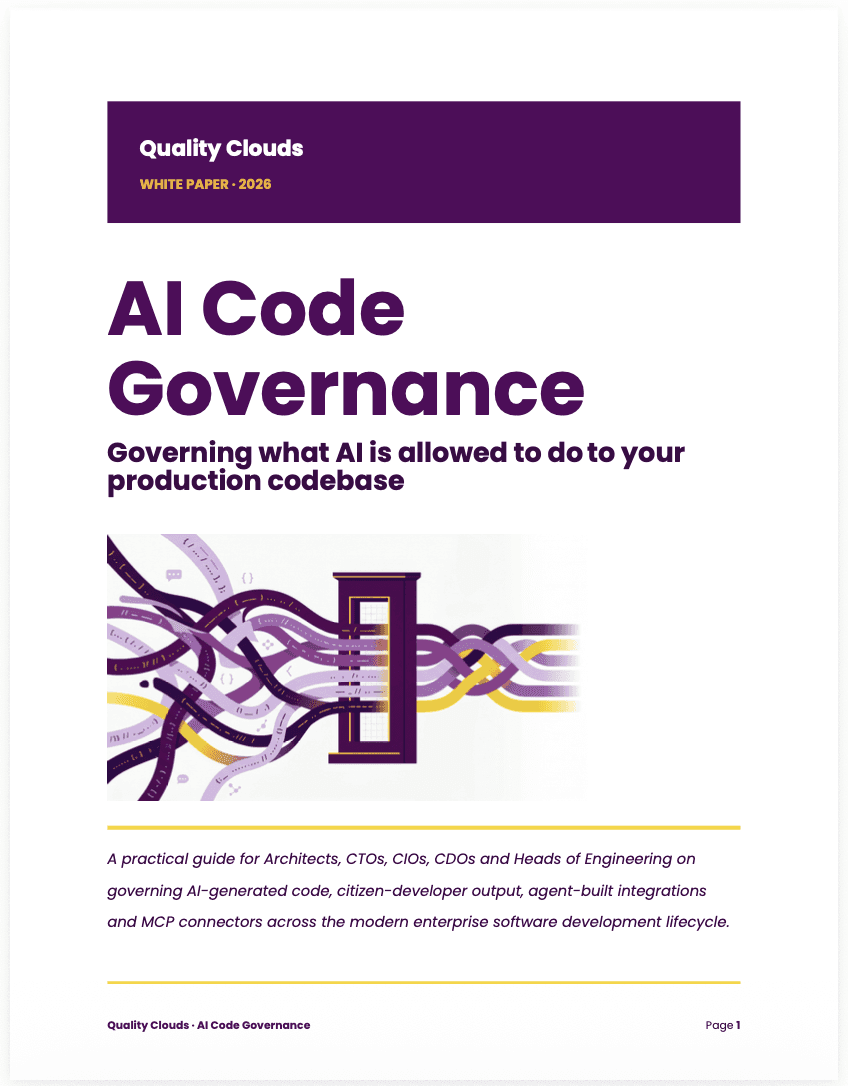
WHITEPAPER
Don't Just Audit AI Code—Enforce Runtime Governance
With frameworks like the EU AI Act taking full effect, finding bugs isn’t enough; you need digital provenance and immutable evidence trails
What Good Looks Like
Rules are current. Standards are reviewed and updated when vendors release new guidance, when regulatory requirements change, and when internal architecture decisions evolve.
Gates are enforced, not advised. Promotion is blocked on critical findings. Teams cannot ship around governance by ignoring a dashboard.
Coverage is complete. Every AI-generated artefact passes through governance — scripts, workflows, integrations, configurations, and agentic logic alike.
Findings reach developers in context. Governance tooling integrates with development environments so that findings are actionable at the point of creation, not discovered weeks later during an audit.
The Answer to the Question
Is your AI code safe to ship? Without a structured AI Code Governance process, the honest answer is: you do not know. You know it functions. You do not know whether it is secure, compliant, or aligned with your standards.
The organisations that deploy AI-generated code with confidence treat governance as a mandatory layer in the delivery pipeline — enforced, automated, and continuous. They use Quality Clouds to define their standards, scan every promotion, enforce gates, and monitor production. Their AI tools generate fast. Their governance layer makes that speed safe.
Production-Ready AI Code is not a property of the tool that generates it. It is the outcome of a governance process that validates it.
Frequently Asked Questions

Albert Franquesa
Co-Founder & CSO, Quality Clouds
Related articles
Stay ahead of the curve
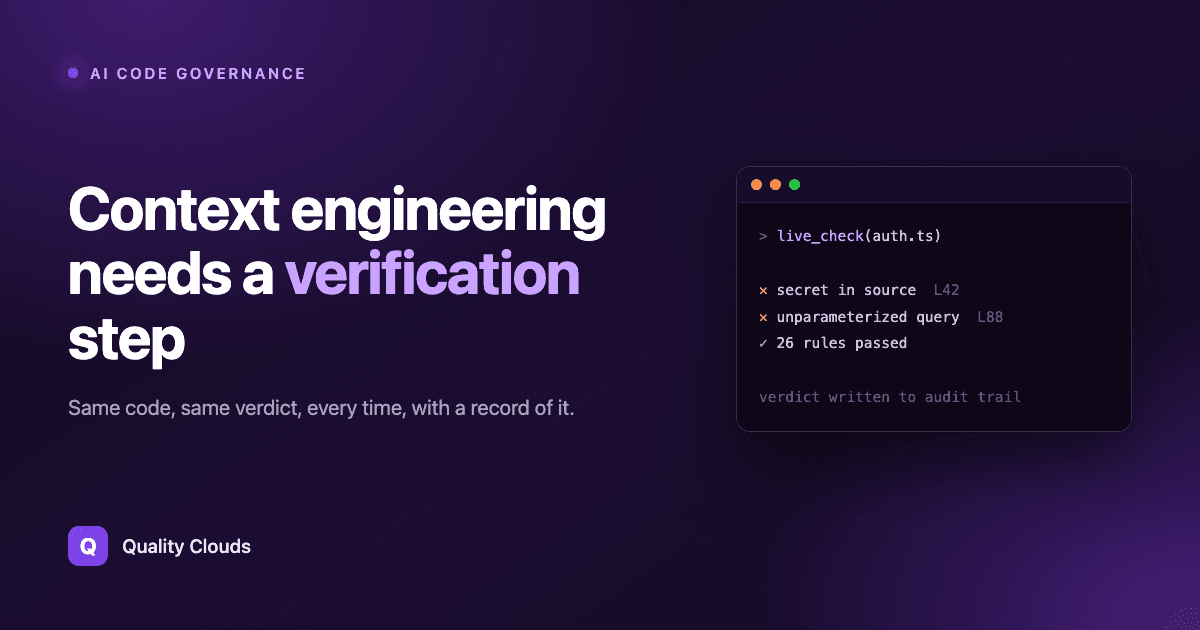
Context engineering needs a verification step
Albert Franquesa
5 min read
Better context raises the odds that AI-generated code is good. It does not tell you whether any particular file is. Here is where the check goes.

Claudeforce makes Salesforce headless. Governance has to move with it

Taher Dohadwala
6 min read
Salesforce is going headless. Learn what changes and how to govern what the agents build

Your Vibe Coded App Probably Has a Security Hole. Here Is How to Find It.
Albert Franquesa
10 min read
The five security holes AI keeps writing into vibe coded apps, and how to find yours in about two hours.