
Salesforce is rolling out DevOps Center Governance for Agentforce Vibes: 6 admin-set policies that every coding session picks up automatically. Here is what the preview enforces, what it leaves to you, and how to close the gap this week.


Salesforce is adding admin-defined governance to Agentforce Vibes. Jeff Douglas, Product Management Director for Agentforce Vibes, previewed the feature ahead of Dreamforce: DevOps Center Governance, a developer preview that lets admins set coding agent guardrails centrally, with every Vibes session picking them up automatically. The rollout started July 31, 2026 and covers Professional (API), Enterprise, Performance, Unlimited, and Developer editions.
We have spent years arguing that AI-generated code needs governance at the point where the code gets written. Salesforce now agrees.
What ships in the developer preview
The preview includes 6 Salesforce-defined policies, configured from the hub org and enforced across every developer, session, and prompt:
SOQL injection prevention
Unauthorized data access prevention
No destructive commands
No direct production deployment
Compliance check
Security validation
DevOps Center admins enable the policies. Vibes users can see which ones apply to their session, and the agent follows them without being asked. Douglas gives a concrete example: prompt Vibes to query some Account records and it writes the SOQL with WITH USER_MODE, because that is the policy.
Douglas states the design goal directly: "Governance isn't something a developer has to remember to follow. It's how the agent operates."
The roadmap goes further. Org access controls, authorized models, an MCP server whitelist, and token spend caps are all listed as coming after the first release.
Why this matters
A policy in a Confluence page depends on every developer reading it and remembering it under deadline pressure. A policy enforced inside the agent loop applies on every prompt, including at 6pm on a Friday. That is the case we made in Loop Engineering and the Agentic SDLC, and DevOps Center Governance puts Salesforce's weight behind it. It changes the conversation for every platform owner who has been asked "do we really need this?"
It also tells you where Salesforce thinks the risk sits. The 6 launch policies cover security and destructive actions, the failure modes that make headlines. That is the right starting point for a platform vendor. We said much the same when ServiceNow made app governance free: a platform vendor shipping guardrails expands the category.
Salesforce has moved fast here. A few months ago, Headless 360 handed coding agents the keys to the org with 60+ MCP tools and no governance layer to speak of. DevOps Center Governance is the other half of that story arriving.
What the preview does not cover yet
Three scope limits matter when you plan around this.
The policies govern code written inside Agentforce Vibes. Most Salesforce teams also generate code in Cursor, Claude Code, GitHub Copilot, and whatever tools their SI partners bring. Code from those sessions lands in your org without passing through DevOps Center Governance, which is the centralized policy management problem every multi-tool team runs into.
The launch policies are Salesforce-defined. Your trigger framework, bulkification patterns, governor limit handling, naming conventions, FLS handling, and architecture decisions sit outside the enforcement set in this preview.
Generation-time checks are one control point among several. AI-assisted development raises the volume of change hitting your org, and volume raises the cost of anything that slips past the first check. When we scanned 424 AI-generated projects, the same 10 defects kept showing up in code that looked fine on the way out of the model. You still need review at the pull request and the org level.
Extending governance across every agent and every pull request
This is where Quality Clouds for Salesforce fits alongside what Salesforce announced.
The Quality Clouds MCP for Salesforce connects any coding agent to your Salesforce ruleset, so generated Apex, LWC, and metadata get validated in real time against 900+ rules plus your own standards, whichever tool wrote the code. The MCP server whitelist on the Vibes roadmap suggests Salesforce expects exactly this pattern: approved external MCP servers plugged into the agent loop.
The Livecheck Quality for Salesforce extension for VS Code brings the same validation into the editor, with findings shown inline as developers (or their AI assistants) write code, and Quality Gates applied before promotion. You do not need a contract to try it. The extension installs free from the Visual Studio Marketplace, and a free Salesforce trial gives you the ruleset behind it, so a developer can have your standards enforced in their editor this afternoon.
The GitHub integration for Salesforce scans every pull request automatically. It runs a feature branch scan on just the changed metadata, posts results inline in GitHub, and Quality Gates can hold the merge until blockers are fixed. The Full Scan GitHub Action audits the whole org on a schedule, so you catch what entered through paths no PR ever covered. That is the native governance model for Salesforce DevOps we have written about before.
What to do this week
Check your edition and, if you are eligible, ask your DevOps Center admin to enable the developer preview. Review the 6 policies with your security team so you know exactly what is and is not enforced.
Map where AI-generated code actually enters your org: Vibes, Cursor, Copilot, partner tools. Compare that list against what the preview governs. The gap is your current exposure.
Write down the standards you would want enforced beyond the launch set. That list becomes your policy backlog for when custom policies arrive, and it is the ruleset you can enforce today through the Quality Clouds MCP and Livecheck. Our best practices for AI code governance in multi-developer teams is a reasonable starting template.
Add a pull request control. If your Salesforce metadata lives in GitHub, connect the Quality Clouds GitHub integration so every PR gets scanned and Quality Gates decide what merges.
Track the MCP server whitelist item on the Vibes roadmap. Externally governed validation will have an official place inside Vibes sessions. Decide now which servers your org would approve.
The July 31 preview covers the first slice: 6 policies, one agent. Extending enforcement to every agent and every release path is the rest of the job, and you can start it this week.
New to the subject? Start with What Is AI Code Governance?
Install the VS Code extension
Start a free Salesforce trial, and point it at your org.

Taher Dohadwala
ServiceNow & Salesforce PreSales Solution Architect
Related articles
Stay ahead of the curve
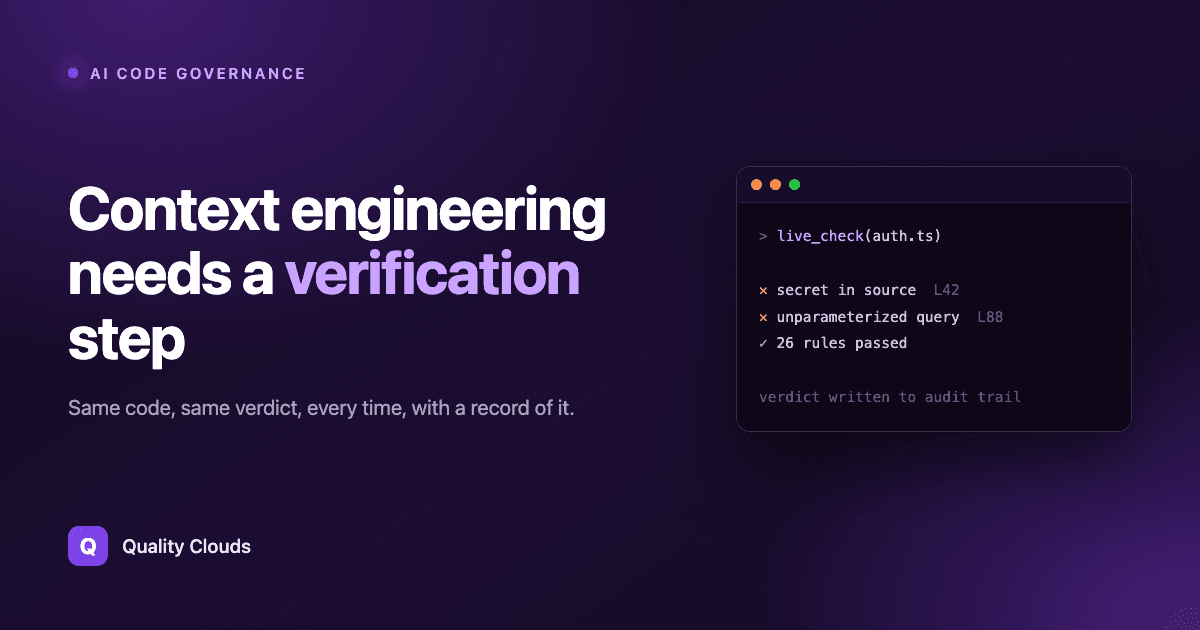
Context engineering needs a verification step

Albert Franquesa
5 min read
Better context raises the odds that AI-generated code is good. It does not tell you whether any particular file is. Here is where the check goes.

Claudeforce makes Salesforce headless. Governance has to move with it
Taher Dohadwala
6 min read
Salesforce is going headless. Learn what changes and how to govern what the agents build

Your Vibe Coded App Probably Has a Security Hole. Here Is How to Find It.
Albert Franquesa
10 min read
The five security holes AI keeps writing into vibe coded apps, and how to find yours in about two hours.