
At Knowledge26, ServiceNow made App Engine Management Center free for all customers. Here is what AEMC actually governs, what it does not, and why that gap makes AI Code Governance more urgent than ever.


Enterprise AI Code Governance: A New Discipline Most Organisations Do Not Yet Have a Tool For
Enterprise AI code governance is a new discipline, and most organisations do not yet have a tool for it. They have testing frameworks, deployment approval workflows, and code review processes designed for human-written code. None of those were built to handle the volume, the patterns, or the risks that come with code generated by AI.
Quality Clouds was built specifically for this. It governs AI-generated code — regardless of which AI tool produced it, regardless of which enterprise platform it runs on — and ensures it meets the security, performance, and architectural standards that production requires.
This matters now because the volume of AI-generated code entering enterprise platforms is accelerating rapidly. And at Knowledge26, ServiceNow made an announcement that will accelerate it further.
What ServiceNow Announced at Knowledge26
ServiceNow announced that App Engine Management Center — its tool for governing the deployment of applications built on the Now Platform — is now available to all customers at no additional cost.
It is a meaningful move. AEMC has historically been a paid addition, and making it free removes a barrier that slowed adoption of governed development practices across many ServiceNow estates. More organisations will now have a structured process for controlling what gets promoted from development to production.
ServiceNow also announced that Build Agent — its AI-native development tool — now works inside Cursor, Windsurf, Claude Code, and GitHub Copilot. Senior engineers and architects no longer need to be inside ServiceNow Studio to build on the platform. They can build from any environment, with full platform context, and deploy through the AEMC governance workflow.
That is a significant expansion of who can build on ServiceNow, and how fast they can do it. And it makes the question of code governance more urgent, not less.
What AEMC Does — and What It Does Not
AEMC governs the process of deploying an application. It manages approval workflows, release pipelines, and the promotion of apps from one environment to another. It gives platform administrators control over who can deploy what, and when.
It is the right tool for that job. Without it, code can reach production without any structured oversight.
But AEMC does not inspect the code inside the application being deployed. It confirms that the right person clicked approve. It does not confirm that what they approved was production-ready.
This gap has always existed in enterprise platform development. It is now more consequential because of what is generating the code.
The Problem ServiceNow Named at Knowledge26
ServiceNow's own vice president at Knowledge26 framed it directly: "Vibe coding is transforming how fast people can build. But speed without governance and an enterprise runtime produce apps that too often look ready but aren't."
That is accurate. AI coding tools can generate a working ServiceNow application in a session that would previously have taken weeks. The application passes basic tests. It goes through the AEMC approval process. And then it reaches production carrying security vulnerabilities, performance risks, and architectural decisions that violate the organisation's own standards — because no one had the tooling to check at the code level.
This is not a problem specific to Build Agent, or to ServiceNow. It is the defining governance challenge for any organisation that has given its engineers access to AI coding tools — which, in 2026, is most of them.
WHITEPAPER
The Missing Layer in ServiceNow Governance
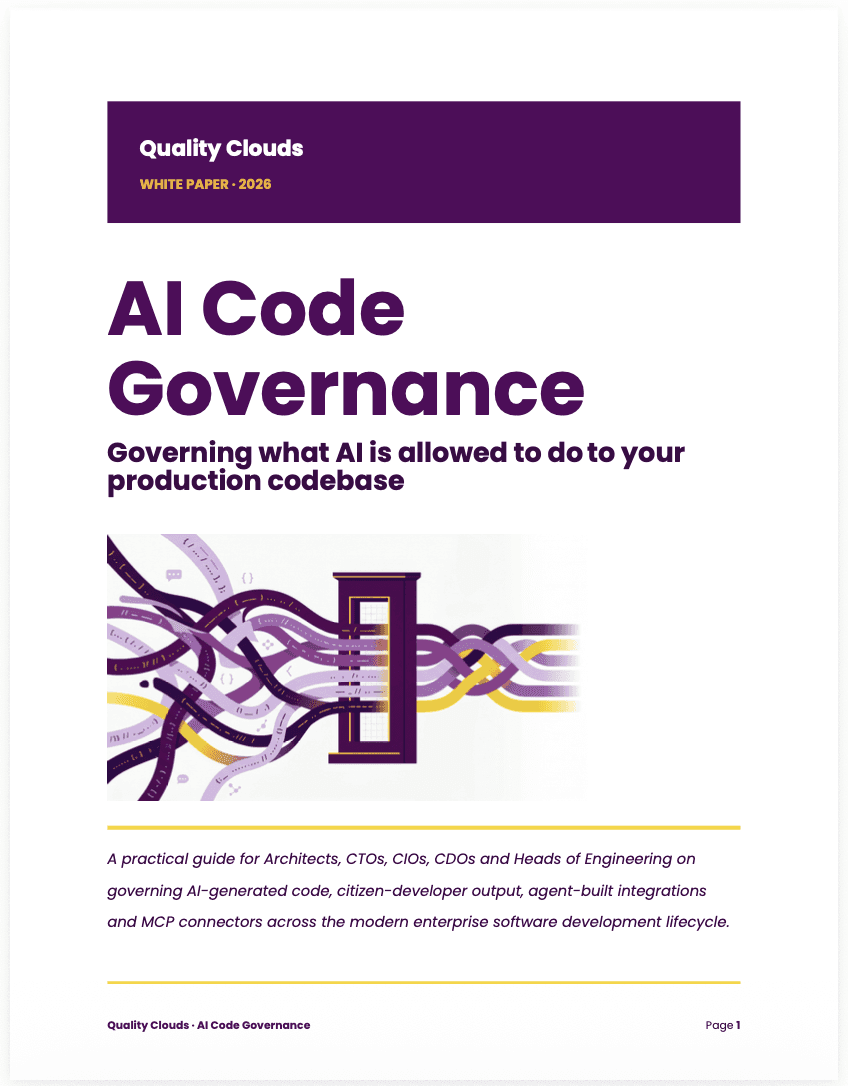
With 62% of enterprise code now authored by AI agents, your legacy security rules are obsolete. Download the 2026 White Paper to bridge the gap between "Vibe Coding" and production-grade security
AI Code Governance: What It Is and Who Needs It
AI Code Governance is the discipline of ensuring that code produced by AI tools meets the same enterprise standards as code written by an experienced human engineer — before it reaches production.
It is not the same as testing. Testing tells you whether the code runs. AI Code Governance tells you whether the code is built correctly: whether it is secure, whether it will perform under load, whether it will survive the next platform upgrade, whether it follows your organisation's architectural patterns.
It is not the same as a deployment approval workflow. An approval workflow confirms that a process was followed. AI Code Governance confirms that the output of that process is safe.
Quality Clouds is built for the senior engineers, architects, and platform leads who are accountable for what runs on their enterprise platforms. These are the people who know that a bad customisation does not just cause an incident — it causes a P1 at 2am, an upgrade project that takes six months longer than planned, or a compliance finding that traces back to a script no one reviewed properly. They are the people who, as AI tools accelerate development across their organisations, are being asked to maintain quality standards without adding headcount.
For CISOs and CTOs, Quality Clouds answers a question that becomes harder to ignore as AI-generated code volumes increase: do you know what is actually running in your enterprise platforms, and does it meet your standards?
Any AI Tool. Any Enterprise Platform.
AI-generated code is produced by many tools — Build Agent, Claude Code, Cursor, Windsurf, GitHub Copilot, Lovable, Replit — and it runs on many platforms. A large enterprise is rarely running only ServiceNow or only Salesforce. It is running both, often with different teams, different release cadences, and different governance maturity levels.
Quality Clouds governs AI-generated code across ServiceNow and Salesforce from a single platform. It also integrates directly into the AI coding tools that generate that code — so that a senior engineer using Cursor or Claude Code to build a ServiceNow workflow gets governance feedback in real time, before the code reaches any approval gate.
In practice, this means four things:
LivecheckAI gives inline governance feedback as code is being written — inside the IDE, at the moment of generation, before a single line reaches a repository.
Quality Gates run automatically in CI/CD pipelines — GitHub Actions, GitLab CI, Azure DevOps, Bitbucket — and block deployments that fail governance thresholds. These are not functional tests. They are governance checks: security rules, performance standards, upgrade risk assessment, architectural compliance.
The AI Rule Builder allows platform CoEs to define governance rules specific to AI-generated code patterns. The patterns that Build Agent, Claude Code, and Cursor tend to produce are different from the patterns human engineers produce. The governance rules need to reflect that.
Full Scan maps every customisation across a ServiceNow or Salesforce instance — not just the apps in the current deployment queue, but everything that has accumulated over years of development. For a platform team that has been running ServiceNow for a decade, this is the starting point: understanding the full technical debt picture before accelerating further with AI tooling.
How Quality Clouds and AEMC Work Together
These are not competing products. They operate at different layers of the same governance problem.
AEMC manages the deployment workflow. Quality Clouds governs the code inside what is being deployed. The output of Quality Clouds directly informs the AEMC process: a Quality Gate failure is a clear signal that an approval should be withheld. A Full Scan result gives the platform team the risk context they need to make informed deployment decisions.
One terminology note worth being precise on: ServiceNow describes Build Agent's validation capability as quality gates. Quality Clouds uses the same term — Quality Gates — for its governance enforcement checks. These are different things. ServiceNow's quality gates are functional validation: does the code run? Quality Clouds' Quality Gates are governance standards enforcement: is the code secure, performant, and architecturally sound? Both are useful. They operate at different levels.
The complete governance stack requires both layers. Strong deployment governance without code governance approves well-managed deployments of poorly written code. Strong code governance without deployment governance produces high-quality code that still reaches production without proper oversight.
The Question for Platform Leaders in 2026
If your organisation is expanding its use of AI coding tools — and the announcements at Knowledge26 suggest that pace is about to accelerate significantly — the volume of AI-generated code entering your ServiceNow and Salesforce environments will increase.
The question for every senior engineer, architect, and platform lead accountable for what runs on those platforms is straightforward: do you have a governance layer that was built for this?
Testing frameworks were not. Deployment approval workflows were not. Manual code review does not scale to the volume that AI tools produce.
Quality Clouds was.
See what your ServiceNow or Salesforce instance looks like through an AI code governance lens
If you want to see what your ServiceNow or Salesforce instance looks like through an AI code governance lens, Quality Clouds Hub is available without a sales conversation at portal.qualityclouds.ai.
Frequently Asked Questions

Albert Franquesa
Co-Founder & CSO, Quality Clouds
Related articles
Stay ahead of the curve
Context engineering needs a verification step
Albert Franquesa
5 min read
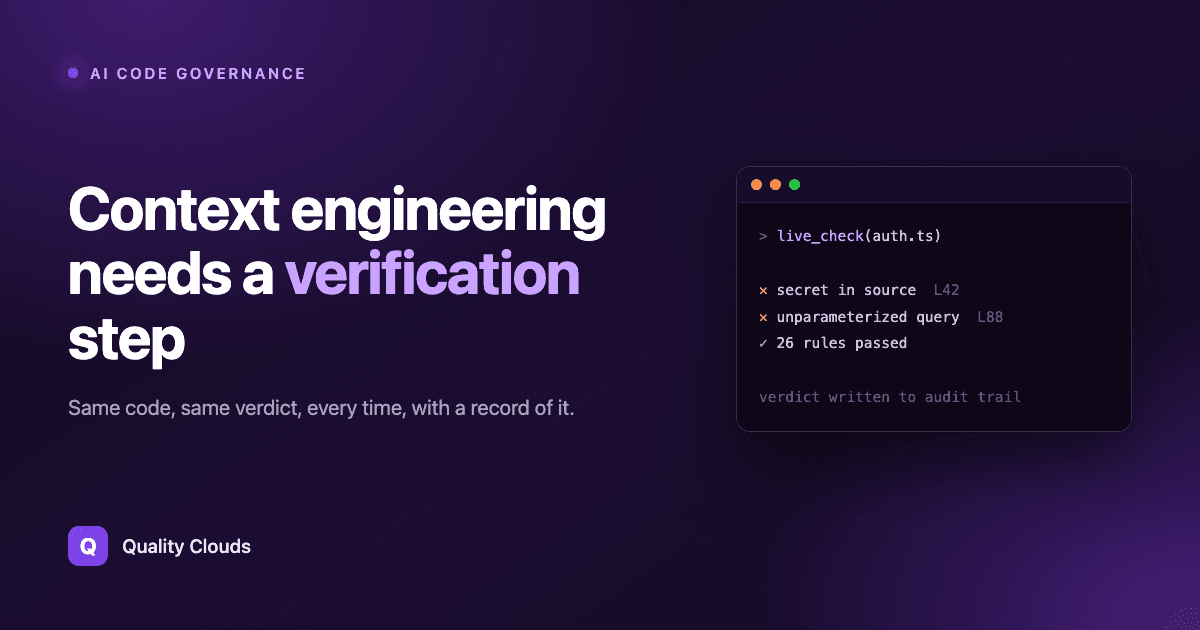
Better context raises the odds that AI-generated code is good. It does not tell you whether any particular file is. Here is where the check goes.

Claudeforce makes Salesforce headless. Governance has to move with it

Taher Dohadwala
6 min read
Salesforce is going headless. Learn what changes and how to govern what the agents build

Your Vibe Coded App Probably Has a Security Hole. Here Is How to Find It.
Albert Franquesa
10 min read
The five security holes AI keeps writing into vibe coded apps, and how to find yours in about two hours.