
Learn how to run a Lovable health check before go-live. Catch RLS gaps, hardcoded secrets, and GDPR failures with Quality Clouds AI code governance


Before you promote a Lovable app to production, it needs a code review. Not a casual glance — a structured Lovable health check that catches the security gaps, architectural debt, and compliance failures that the AI won't tell you about.
The rise of "vibe-coding" via platforms like Lovable or Replit has fundamentally changed the speed at which business units can innovate. What used to take a specialised engineering team six months can now be prompted into existence by a savvy business user in a single afternoon. However, for IT and Security teams, this velocity introduces a significant governance gap — and closing it requires a dedicated layer of AI code governance.
Quality Clouds provides the AI code governance layer that sits between your Lovable developers and your production environment — ensuring that what gets built fast also gets built right.
What Is a Lovable Health Check?
A Lovable health check is a structured review of an AI-generated application — covering security posture, code quality, dependency management, and GDPR compliance — before it is promoted to a production environment. It is the applied practice of AI code governance: ensuring that code generated at speed meets the standards required for enterprise use.
Unlike a penetration test, which probes live endpoints, a health check performs static analysis of the source code to identify risks that would never surface in a sandbox.
A complete Lovable health check covers four layers:
Security: RLS policy coverage, authentication guard logic, hardcoded secrets, PII handling
Code Quality: component size, React Hook hygiene, dependency pinning, "context rot"
Compliance: GDPR, encryption at rest, data retention rules
Performance: Supabase query efficiency, infinite recursion patterns, memory leaks
The Problem: Common Pitfalls in "Vibe-Coded" Apps
The most dangerous aspect of AI-generated code is its "confident" failure. Lovable apps typically use Supabase as a backend, and while the AI is excellent at creating functional UI, it consistently overlooks the invisible security and architectural layers required for enterprise use.
As highlighted in the ML6 report, "The Anatomy of a Lovable App," these projects often follow a "2-tier architecture" where the browser talks directly to the database. This simplicity is powerful, but it places the entire security burden on Row Level Security (RLS) policies — rules that are often generated by the LLM itself.
Through hundreds of audits, we consistently see the following issues:
The RLS Bypass (The "Open Door" Policy): AI often forgets to enable or correctly configure RLS. Without these policies, any user who can see your public Supabase URL can theoretically query your entire database.
Reversed Auth Guards: A common AI "hallucination" involves backwards logic — where the application accidentally blocks logged-in admins but allows anonymous guest access to sensitive routes.
Hardcoded Secrets: Business users often "chat" their API keys directly into the code. If a Secret key is included instead of a publishable key, your entire backend is compromised.
Architectural Debt & "Context Rot": Each AI change is optimised for the immediate request rather than holistic planning. This leads to oversized component files and deeply nested JSX that eventually hits a "complexity ceiling".
The Wake-Up Call: CVE-2025-48757
In early 2025, the industry was rocked by CVE-2025-48757, a critical vulnerability (CVSS 9.3) specifically targeting applications built with rapid AI generators. The vulnerability allowed remote, unauthenticated attackers to read and write to arbitrary database tables because of default insufficient RLS policies.
CVE-2025-48757 — At a Glance CVSS Score: 9.3 (Critical) Attack vector: Remote, unauthenticated Root cause: Default insufficient RLS policies in AI-generated Supabase backends Apps affected: 170+ Lovable applications Discovery method: External endpoint probing (pentest-style) |
The 360° Review: Why Pentesting Alone Isn't Enough
Many IT teams believe a standard Penetration Test (Pentest) is the final hurdle. While a pentest (like those provided by Aikido) is essential for identifying "outside-in" exploits like privilege escalation, it is only one half of the puzzle. CVE-2025-48757 was discovered specifically through probing live endpoints.
However, to ensure an app is truly production-ready, you need an "inside-out" Lovable code review. A pentest won't tell you that your app has unpinned dependencies that will break next week, or that your React Hook dependencies are causing a memory leak that will crash the browser for 20% of your users.
Quality Clouds fills this gap by performing deep static analysis of the Lovable codebase. We ensure:
Scalability: Is the data fetching logic efficient, or will it incur massive Supabase costs as users grow?
Maintainability: Is the code structured so a future developer can actually fix a bug, or has "context rot" made it a legacy mess?
Performance: Are there "infinite recursion" errors in database policies slowing the UX?
Automated Compliance: GDPR and the Rule Builder
Data privacy is a massive hurdle. Quality Clouds includes a pre-built GDPR Ruleset specifically for low-code apps. This ruleset automatically flags PII being stored in local storage or missing encryption.
Furthermore, our Rule Builder allows IT teams to scaffold "Safe Zones" for Lovable developers. You can define corporate standards — such as "All AI calls must go through an Edge Function" — and Quality Clouds will enforce that rule across every app your business users build. No engineer required.
Continuous Audit: The Quality Clouds Certification
The goal of IT governance shouldn't be to "stop" development, but to "certify" it. By integrating Quality Clouds into the Lovable workflow, every commit is automatically audited against your organisation's AI code governance standards.
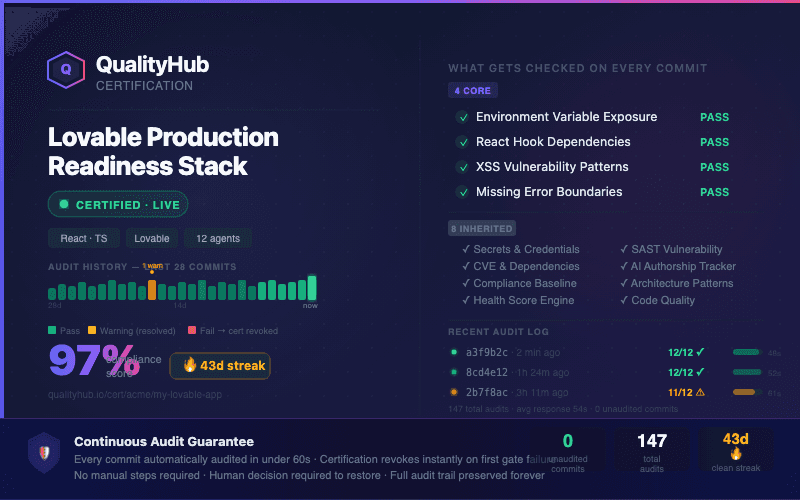
Quality Clouds provides a Continuous Audit Guarantee, breaking the review down into:
Core Checks: Immediate indicators for environment variable exposure, XSS patterns, and missing error boundaries.
Inherited Risks: Ongoing monitoring for CVEs (including CVE-2025-48757) and AI authorship tracker patterns.
The Health Score: A "Compliance Score" and a "Clean Streak" counter. This gamifies quality for your business users while giving IT a high-level view of the organisation's risk posture.
The Lovable Code Review Checklist for IT Teams
Before certifying any Lovable app for production use, validate every item below:
Row Level Security (RLS) enabled on all Supabase tables
No hardcoded API keys or service role credentials in client-side code
Authentication guard logic verified (no reversed allow/deny logic)
All third-party API calls routed through Edge Functions
PII fields encrypted at rest; no PII stored in localStorage
Dependency versions pinned (no floating ^ versions on security-critical packages)
Component files under 500 lines (no "context rot")
React Hook dependencies declared correctly (no memory leak patterns)
GDPR "Delete My Data" workflow present if handling end-user data
CVE monitoring active — including CVE-2025-48757 pattern checks
Closing the Loop: The AI Remediation Prompt
The biggest friction point in IT review is the "Fix Request." Usually, IT sends a 20-page PDF of errors to a business user, who has no idea how to fix the code.
Quality Clouds solves this by speaking the same language as Lovable. For every issue found by LiveCheckAI, we generate a remediation prompt that the user can paste directly back into Lovable:
Quality Clouds identifies a high-risk issue (e.g., "Missing auth.uid() check in RLS policy")
We generate a specific Lovable prompt: "Rewrite the RLS policy for the 'profiles' table to ensure users can only update rows where the ID matches auth.uid()."
The user pastes it into Lovable — the AI fixes the code instantly.
The result: a seamless Review → Prompt → Fix loop that lets business users maintain their speed while meeting the most stringent IT security requirements.
Conclusion: Enable, Don't Block
The vibe-coding revolution is here to stay. IT teams that try to block these tools will only encourage Shadow IT. The alternative is to provide a paved path: allow the use of Lovable, but require a Quality Clouds certification before any app reaches production.
By combining Aikido's penetration testing with Quality Clouds' Lovable code review and health check, you ensure that every app in your ecosystem is not just functional — but secure, scalable, and enterprise-grade. This is AI code governance in practice: not blocking development, but certifying it.
The goal is simple: Production-Ready AI Code. Quality Clouds is how you get there.
Ready to run your first Lovable health check?
Quality Clouds integrates directly into your Lovable workflow — no engineers required
Frequently Asked Questions: Lovable Code Review

Albert Franquesa
Co-Founder & CSO, Quality Clouds
Related articles
Stay ahead of the curve
Context engineering needs a verification step
Albert Franquesa
5 min read
Better context raises the odds that AI-generated code is good. It does not tell you whether any particular file is. Here is where the check goes.

Claudeforce makes Salesforce headless. Governance has to move with it

Taher Dohadwala
6 min read
Salesforce is going headless. Learn what changes and how to govern what the agents build

Your Vibe Coded App Probably Has a Security Hole. Here Is How to Find It.
Albert Franquesa
10 min read
The five security holes AI keeps writing into vibe coded apps, and how to find yours in about two hours.