Adobe Commerce in the Agentic Era: Less Code, More Control

Adobe Commerce in the Agentic Era: Less Code, More Control

Gain proven strategies and best practices for platform owners, architects, developers, CIOs, release managers, and QA leaders.

Adobe

AI Code Governance

Event & Insights

adobe-commerce-agentic-era-less-code-more-control

Table of content

At Adobe Summit 2026, Adobe announced two tools that change how enterprise commerce teams operate: the Commerce MCP Server and the Commerce Developer Agent. Neither announcement was incremental. Together, they signal a structural shift in how Adobe Commerce code gets written — and who, or what, writes it.

For commerce teams at enterprise scale, that shift creates an immediate and practical challenge. Development speed is no longer the primary constraint on what gets built. The new differentiator is AI Code Governance: the policies, automated checks, and audit infrastructure that determine whether AI-generated code can be trusted in production.

Adobe Commerce Now Has Two Audiences

Adobe Commerce has historically been a platform built for human developers. Customisation required PHP expertise, familiarity with Magento’s module architecture, and hands-on engagement with the codebase. The Commerce MCP Server changes that baseline.

The Commerce MCP Server gives AI agents secure, real-time access to the full commerce surface: catalogue, cart, pricing, inventory, promotions, checkout, order management, and post-purchase flows. An agent querying this server can read live product data, coordinate transactions, and act across the platform without a developer writing integration code for each capability.

The Commerce Developer Agent addresses the development process directly. It analyses an existing Adobe Commerce implementation and maps a migration path from legacy PHP and custom code to modern, event-driven app components aligned with Adobe’s best practices. Teams use it to accelerate migration to Adobe Commerce as a Cloud Service and to generate new storefront components from natural language instructions rather than writing every line by hand.

Together, these tools redesign the development workflow. A senior engineer who once spent weeks migrating a legacy module can direct the Commerce Developer Agent to produce a detailed roadmap and a first code draft in a fraction of that time. A commerce architect connecting catalogue data to a shopping assistant uses the Commerce MCP Server rather than building a custom API layer from scratch.

Development velocity is no longer the bottleneck. That changes everything downstream.

The Risk That Arrives With the Speed

AI agents generate code at a different scale than human developers. A developer writes, reviews, and commits changes deliberately — hours or days per feature. An agent produces a complete migration or a set of new storefront components in minutes.

That velocity compounds. A team deploying the Commerce Developer Agent across a large implementation can generate more code in a week than the same team might produce in a month through conventional development. Each generated artefact carries the same risk profile as any other custom code: it can conflict with platform conventions, introduce security vulnerabilities, break upgrade paths, or fail to meet an organisation’s compliance requirements.

The problem is not the speed. The problem is what happens when speed outpaces accountability.

In a traditional development workflow, a human writes the code, a reviewer approves it, and a deployment log captures who authorised what. AI-generated code does not carry an audit trail by default. Without explicit governance — defined policies, automated review gates, and structured logging — the question of who authorised a change and whether it meets organisational standards becomes very difficult to reconstruct.

In regulated industries, that inability to answer is a compliance exposure. Frameworks including DORA, the EU AI Act, and SOC 2 require organisations to demonstrate that changes to production systems meet defined standards and carry an evidenced approval record. AI-generated code is not exempt from those requirements simply because no human wrote it.

The question commerce teams must now answer is not whether they can build something — the Commerce Developer Agent makes that trivial. The question is whether they know what was built, by whom, and whether they can prove it met their standards before it went live.

WHITEPAPER

Why Your AI Strategy is Only as Good as Your Guardrails

Download the Definitive Guide to Managing Agentic Risk in Adobe Commerce
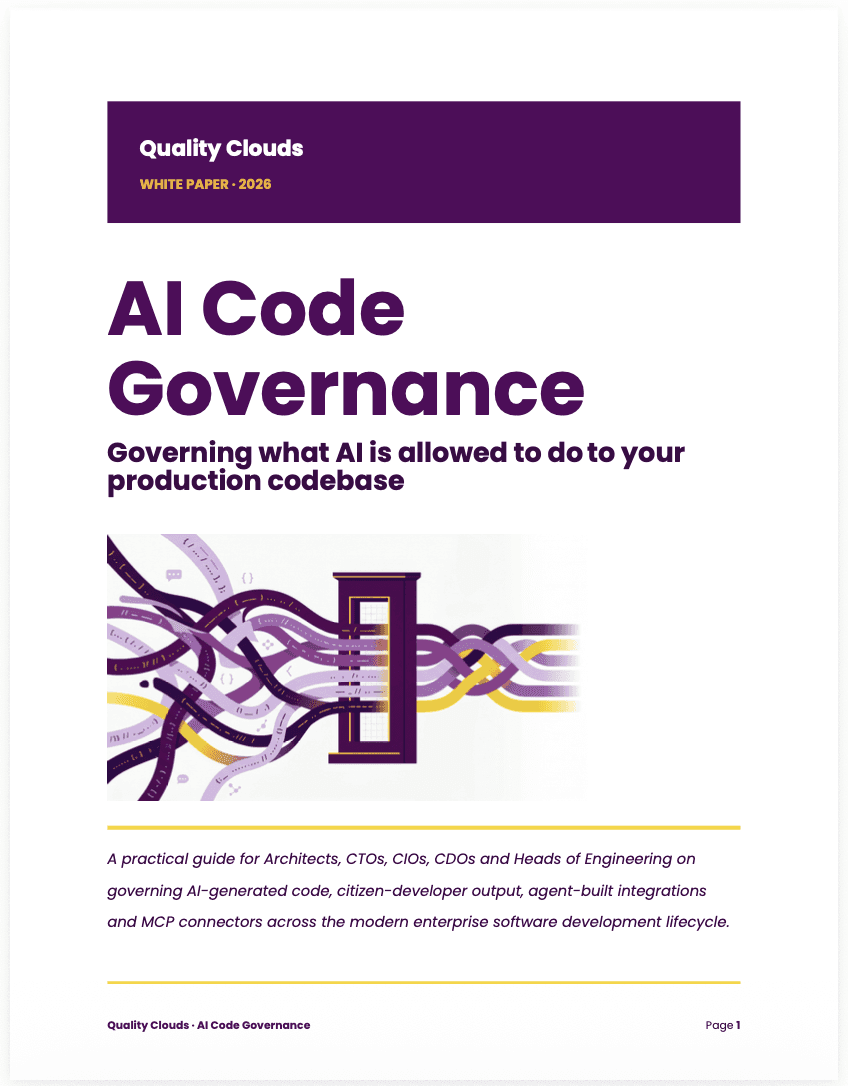
AI Code Governance White Paper 2026

Policies Are the New Competitive Edge

Answering that question requires a governance layer that sits above the code and validates it before deployment. This is precisely what Quality Clouds provides for Adobe Commerce teams.

The Quality Clouds AI Rule Builder lets business developers — not just platform engineers — define what good Adobe Commerce code looks like. A compliance lead can encode the rule that no custom module should bypass standard authentication flows. A platform architect can specify that all generated app components must conform to Adobe Commerce as a Cloud Service conventions. A security team can require that no code touching checkout exposes raw customer data in logs.

These policies are not static checklists. They execute as automated checks against every piece of code entering the pipeline — including code produced by the Commerce Developer Agent. Quality Gates enforce those checks at defined workflow stages, before any artefact reaches staging or production.

LivecheckAI extends this further. Rather than waiting for a scheduled review, it applies governance rules in real time as AI agents generate output. Teams configure LivecheckAI to flag or block any code that breaches an active policy before a developer encounters it.

For teams conducting a full assessment of their Adobe Commerce estate — particularly those planning a migration from legacy implementations — Full Scan provides a comprehensive analysis of the existing codebase against the complete active policy set. Technology and compliance leaders get a clear, evidenced picture of what requires remediation before AI-generated changes are layered on top.

The Skill That Matters Most Has Changed

In a conventional commerce team, the most valued technical contributor writes clean, well-structured PHP. In an agentic commerce team, the most valued contributor can articulate precise governance rules and interpret the audit trail those rules produce.

A well-maintained AI Rule Builder policy library, curated by a commerce architect who understands Adobe Commerce conventions, catches more problems more consistently than any manual review process. Organisations that invest in that library now — in policies, rule sets, and audit infrastructure — operate the agentic model with confidence. Those that do not accumulate risk at the same velocity their agents generate code.

Auditability Is Deployment Confidence

In an agentic development environment, deployment confidence comes from the audit trail, not from the belief that a human reviewed every line.

When a technology director asks whether a release is safe to deploy, the answer must be evidence: here is the policy check record, here is what passed, here is what was remediated, and here is the sign-off log. Quality Clouds produces that record. Every Quality Gates run, every LivecheckAI validation, and every Full Scan result contributes to an evidence trail that teams can present to internal governance committees and external auditors.

AI Code Governance is the layer that converts agentic development from a speed advantage into a durable operational model. Without it, the Commerce MCP Server and the Commerce Developer Agent are powerful tools operating without a safety mechanism. With it, they become the foundation for a faster, more accountable, Production-Ready AI Code delivery pipeline — one that commerce teams can operate with confidence, at scale, and under audit.

Stop Guessing. Start Governing

The transition to agentic commerce is happening now. Ensure your team is leading the shift, not cleaning up the aftermath

Frequently Asked Questions

What is AI Code Governance, and why does it matter for Adobe Commerce teams?

AI Code Governance is the set of policies, automated checks, and audit processes that determine whether code — including code generated by AI tools — meets an organisation’s technical, security, and compliance standards before it reaches production. In the Adobe Commerce context, this means validating customisations, migration artefacts, and AI-generated app components against platform best practices and business rules, then recording the outcome of every check. As AI agents produce code at volume, governance is the mechanism that keeps that output trustworthy.

Does AI-generated Adobe Commerce code need to comply with DORA or the EU AI Act?

Regulatory obligations apply to the organisation and the system, not to the author of the code. DORA requires financial entities to demonstrate resilience and oversight over changes to critical digital infrastructure. The EU AI Act imposes accountability requirements on AI-augmented workflows in high-risk contexts. Organisations cannot exempt code from these frameworks by attributing its authorship to an AI agent. An audit trail recording which policies applied, what passed, and what was remediated is essential compliance evidence under both frameworks.

How does the Quality Clouds AI Rule Builder differ from Adobe’s native code validation?

Adobe’s tooling focuses on technical correctness and upgrade compatibility within the platform’s own defined standards. The AI Rule Builder extends that scope to cover an organisation’s business rules, security policies, and compliance requirements — logic Adobe cannot know or enforce centrally. A team might require that no custom payment integration deploys without a specific approval tag, or that all AI-generated components pass a named security check. These are organisational policies, not platform defaults.

Quality Clouds vs manual code review: which is more effective for AI-generated output?

Manual code review depends on a developer reading and approving each change individually. At the volume AI agents generate code, that process becomes a structural bottleneck — or it gets bypassed under time pressure. Quality Clouds encodes review logic as automated policies that execute against every artefact, consistently, without a reviewer examining each file. It scales with the output rate of the agent, not with the size of the engineering team.

Can non-technical team members use the AI Rule Builder to define governance policies?

Yes. The AI Rule Builder is designed so that business developers, compliance leads, and platform architects can define and maintain governance rules without writing code. A compliance officer can encode data handling obligations as enforceable policies. A commerce operations manager who knows which customisation patterns cause upgrade failures can flag those patterns automatically. The technical implementation of the check sits within Quality Clouds. The knowledge that defines the rule sits within the team.

What is AI Code Governance, and why does it matter for Adobe Commerce teams?

AI Code Governance is the set of policies, automated checks, and audit processes that determine whether code — including code generated by AI tools — meets an organisation’s technical, security, and compliance standards before it reaches production. In the Adobe Commerce context, this means validating customisations, migration artefacts, and AI-generated app components against platform best practices and business rules, then recording the outcome of every check. As AI agents produce code at volume, governance is the mechanism that keeps that output trustworthy.

Does AI-generated Adobe Commerce code need to comply with DORA or the EU AI Act?

Regulatory obligations apply to the organisation and the system, not to the author of the code. DORA requires financial entities to demonstrate resilience and oversight over changes to critical digital infrastructure. The EU AI Act imposes accountability requirements on AI-augmented workflows in high-risk contexts. Organisations cannot exempt code from these frameworks by attributing its authorship to an AI agent. An audit trail recording which policies applied, what passed, and what was remediated is essential compliance evidence under both frameworks.

How does the Quality Clouds AI Rule Builder differ from Adobe’s native code validation?

Adobe’s tooling focuses on technical correctness and upgrade compatibility within the platform’s own defined standards. The AI Rule Builder extends that scope to cover an organisation’s business rules, security policies, and compliance requirements — logic Adobe cannot know or enforce centrally. A team might require that no custom payment integration deploys without a specific approval tag, or that all AI-generated components pass a named security check. These are organisational policies, not platform defaults.

Quality Clouds vs manual code review: which is more effective for AI-generated output?

Manual code review depends on a developer reading and approving each change individually. At the volume AI agents generate code, that process becomes a structural bottleneck — or it gets bypassed under time pressure. Quality Clouds encodes review logic as automated policies that execute against every artefact, consistently, without a reviewer examining each file. It scales with the output rate of the agent, not with the size of the engineering team.

Can non-technical team members use the AI Rule Builder to define governance policies?

Yes. The AI Rule Builder is designed so that business developers, compliance leads, and platform architects can define and maintain governance rules without writing code. A compliance officer can encode data handling obligations as enforceable policies. A commerce operations manager who knows which customisation patterns cause upgrade failures can flag those patterns automatically. The technical implementation of the check sits within Quality Clouds. The knowledge that defines the rule sits within the team.

What is AI Code Governance, and why does it matter for Adobe Commerce teams?

AI Code Governance is the set of policies, automated checks, and audit processes that determine whether code — including code generated by AI tools — meets an organisation’s technical, security, and compliance standards before it reaches production. In the Adobe Commerce context, this means validating customisations, migration artefacts, and AI-generated app components against platform best practices and business rules, then recording the outcome of every check. As AI agents produce code at volume, governance is the mechanism that keeps that output trustworthy.

Does AI-generated Adobe Commerce code need to comply with DORA or the EU AI Act?

Regulatory obligations apply to the organisation and the system, not to the author of the code. DORA requires financial entities to demonstrate resilience and oversight over changes to critical digital infrastructure. The EU AI Act imposes accountability requirements on AI-augmented workflows in high-risk contexts. Organisations cannot exempt code from these frameworks by attributing its authorship to an AI agent. An audit trail recording which policies applied, what passed, and what was remediated is essential compliance evidence under both frameworks.

How does the Quality Clouds AI Rule Builder differ from Adobe’s native code validation?

Adobe’s tooling focuses on technical correctness and upgrade compatibility within the platform’s own defined standards. The AI Rule Builder extends that scope to cover an organisation’s business rules, security policies, and compliance requirements — logic Adobe cannot know or enforce centrally. A team might require that no custom payment integration deploys without a specific approval tag, or that all AI-generated components pass a named security check. These are organisational policies, not platform defaults.

Quality Clouds vs manual code review: which is more effective for AI-generated output?

Manual code review depends on a developer reading and approving each change individually. At the volume AI agents generate code, that process becomes a structural bottleneck — or it gets bypassed under time pressure. Quality Clouds encodes review logic as automated policies that execute against every artefact, consistently, without a reviewer examining each file. It scales with the output rate of the agent, not with the size of the engineering team.

Can non-technical team members use the AI Rule Builder to define governance policies?

Yes. The AI Rule Builder is designed so that business developers, compliance leads, and platform architects can define and maintain governance rules without writing code. A compliance officer can encode data handling obligations as enforceable policies. A commerce operations manager who knows which customisation patterns cause upgrade failures can flag those patterns automatically. The technical implementation of the check sits within Quality Clouds. The knowledge that defines the rule sits within the team.


As Co-Founder and CSO at Quality Clouds, I lead our strategic vision and market expansion to help enterprises redefine their technical standards through AI Code Governance

As Co-Founder and CSO at Quality Clouds, I lead our strategic vision and market expansion to help enterprises redefine their technical standards through AI Code Governance

Albert Franquesa

Co-Founder & CSO, Quality Clouds

Don't just follow the change. Lead it

Subscribe to our newsletter

Don't just follow the change. Lead it

Subscribe to our newsletter

Don't just follow the change. Lead it

Subscribe to our newsletter