
How Quality Clouds brings continuous integration discipline to Adobe Commerce PHP teams working with AI coding tools



The Magento and Adobe Commerce ecosystem has always rewarded engineers who understand its depth. Custom modules, EAV architecture, plugin interception, declarative schema, GraphQL resolvers, service contracts — this is not a stack you learn in a weekend. It rewards experience, attention to detail, and a solid understanding of how changes propagate through a complex system.
For years, that depth was also the argument against AI-assisted development in the Adobe Commerce world. "The AI doesn't understand Magento's extension architecture." "It won't know when to use a plugin vs. a preference." "It'll generate code that works in isolation and breaks the checkout."
That argument is losing ground fast.
AI Can Now Work Effectively in the Magento Stack
The latest generation of AI coding assistants - Cursor, GitHub Copilot, Claude, and others — has reached a level of Magento-specific competence that would have seemed implausible two years ago. Given the right context, these tools can:
Generate well-structured Magento 2 modules with proper [
registration.php) module.xml), and (di.xml) configurationWrite plugins and observers that follow Magento's interception patterns correctly
Implement repository pattern classes with appropriate interfaces and service contracts
Handle declarative schema for database changes instead of falling back to install scripts
Produce GraphQL resolvers and schema definitions aligned with Adobe Commerce conventions
Generate unit and integration tests using the Magento testing framework
This is not theoretical. Agencies and merchants are already using AI tools to accelerate module development, port Magento 1 customizations, and build third-party integrations at a pace that was not possible before.
The productivity gains are real. And they come with a specific new category of risk that the Magento community has not had to manage before.
The New Risk: AI-Generated Code Without Magento-Aware Quality Gates
When a senior Magento developer writes a plugin, they instinctively know things that are not in any documentation: that certain events fire in unexpected order during checkout, that session handling behaves differently across store views, that a seemingly harmless preference on a core class can break a third-party module they haven't even installed yet.
AI tools generate code that looks correct. It compiles. It passes basic tests. It often works in development. But it may carry subtle violations of Magento's architectural conventions that only surface under load, during a promotion, or after a module conflict in production.
The problem is not that AI tools are bad at Magento. The problem is that there is no systematic layer between AI-generated code and production that enforces Magento-specific quality standards at scale.
Traditional CI/CD pipelines for Magento catch syntax errors, failed unit tests, and coding standard violations via PHP_CodeSniffer. That is necessary but not sufficient when the code being merged was generated by an AI that may have subtly misunderstood an architectural constraint.
What is missing is a continuous integration layer that understands not just PHP syntax and generic best practices, but the specific rules, patterns, and anti-patterns of the Adobe Commerce platform — and enforces them automatically on every code change, whether that code was written by a human or an AI.
Continuous Integration for Magento Has Always Been Under-Specified
Ask any Magento agency what their CI/CD pipeline looks like, and you will hear variations of the same answer: PHPUnit for unit tests, PHPCS with Magento Coding Standard, maybe some integration tests, a static analysis pass with PHPStan or Psalm, and a deployment script.
This is a reasonable baseline. But it leaves a significant gap between "code that passes the pipeline" and "code that is safe to run in a production Magento store."
The gap includes questions like:
Is this plugin intercepting the right method at the right point in the lifecycle?
Does this observer handle exceptions in a way that won't silently swallow errors during order processing?
Is this repository implementation following the service contract pattern, or is it making direct model calls that will cause problems in a headless or API-first context?
Does this new module declare its dependencies correctly, so it does not fail during module sequence resolution?
Is this caching implementation respecting Magento's cache invalidation patterns, or will it serve stale data after a product update?
Is this custom checkout step registered in the correct position in the layout XML hierarchy?
None of these questions are answered by a standard PHPCS run or a PHPUnit suite. They require Magento-specific rules that encode the platform's architectural expectations — rules that historically lived only in the heads of senior developers and in expensive code review cycles.
Quality Clouds: Magento-Aware Quality Rules
Quality Clouds brings a different approach to this problem. Instead of shipping a fixed set of generic PHP rules, it introduces the concept of AI agents scoped to your technology stack generate and enforce quality rules specifically tailored to the libraries, frameworks, and architectural patterns present in your codebase.
For a Magento project, this means the scanning agent understands that it is looking at Adobe Commerce code. It knows the difference between a plugin and a preference, between an observer and an interceptor, between a declarative schema migration and an install script. It enforces rules derived from Magento's own architectural guidelines and from the accumulated knowledge of how this platform breaks in production.
What this looks like in practice
Stack Profile Auto-Discovery
When you connect a Magento repository to Quality Clouds, the platform scans your dependency manifests, configuration files, and code structure to build a Stack Profile. It detects:
Magento/ Adobe Commerce version (2.4.5, 2.4.6, 2.4.7...)
PHP version and configuration
Third-party modules and their versions (Amasty, Mageworx, Klevu, etc.)
Whether the store is headless (PWA Studio, Hyva, Vue Storefront)
Infrastructure signals (Redis, Elasticsearch/OpenSearch, Varnish)
Custom module structure and naming conventions
This Stack Profile becomes the context that drives the scanning agents. Rules are not generic — they are calibrated to your specific version of Magento and your specific combination of third- party modules.
Magento-Specific Quality Rules
Based on the Stack Profile, Quality Clouds generates and enforces rules such as:
Module architecture
Module declaration completeness (registration.php, module.xml, composer.json alignment)
Correct use of dependency injection vs. object manager direct calls
Service contract implementation patterns
Repository pattern compliance
Plugin and observer safety
Plugin method signature correctness
Observer exception handling patterns
Event area declarations (frontend/adminhtml/global)
Circular plugin chain detection
Database and schema
Declarative schema usage vs. deprecated install scripts
Direct SQL query detection in business logic
Missing indexes on filterable attributes
Caching and performance
Cache type declaration and invalidation patterns
N+1 query patterns in collection loading
Full page cache hole-punching correctness
API and integration
REST and GraphQL endpoint security patterns
Service contract versioning
Input validation in custom API endpoints
Checkout and order processing
Payment method implementation completeness
Observer order safety during checkout flow
Quote and order data mutation patterns
Auto-Fix with Magento Context
When Quality Clouds detects a violation, it does not just flag it — it generates a fix recommendation that understands the Magento context. A recommendation to replace an object manager call with a constructor-injected dependency comes with the correct di.xml configuration snippet, not just a generic "use dependency injection" suggestion.
These fix recommendations are delivered directly into your AI coding environment via the Quality Clouds MCP server, so Cursor or Copilot can apply them with full awareness of what the fix requires in a Magento project specifically.
CI/CD Integration: Quality Gates on Every Pull Request
Quality Clouds integrates directly into your existing CI/CD pipeline. Every pull request triggers a scan, and the results are surfaced where developers already work — in the PR diff, in the AI editor, and in the Quality Clouds dashboard.
The pipeline integration supports:
PR blocking by severity threshold Configure which severity levels block a merge. A critical issue - a direct SQL call in a payment flow, an observer that swallows exceptions during order processing - blocks the PR automatically. A medium issue generates a comment and a recommendation but does not block.
Scan history and trend tracking Every scan generates an execution record. You can see whether the quality of a codebase is improving or degrading over time, which modules are generating the most issues, and whether AI-generated code is introducing new categories of problems.
Multi-repo portfolio visibility For agencies managing multiple merchant codebases common pattern in the Magento partner ecosystem — Quality Clouds provides a portfolio view across all connected repositories. If a new critical vulnerability pattern is detected, you can see at a glance which of your 30 client stores are affected and prioritize remediation accordingly.
The Partner Agency Use Case: Managing Multiple Merchant Codebases
This is where Quality Clouds addresses a problem that is genuinely specific to the Magento partner and agency ecosystem.
A typical Adobe Commerce partner manages between 10 and 50 merchant codebases simultaneously. These stores share some common ground - the platform, some third-party modules, possibly a shared theme or extension library developed in-house — but each has its own customizations, its own data model extensions, and its own history of technical decisions.
Managing quality across this portfolio without a tool like Quality Clouds means one of two things: either you have a senior Magento architect reviewing every PR on every client project (not scalable), or you accept that quality consistency across the portfolio is aspirational rather than enforced.
Quality Clouds changes this equation. The Stack Profile for each merchant codebase is detected automatically. Agents are deployed against each codebase with rules calibrated to its specific version and module combination. Issues are surfaced consistently. And when you develop a shared extension library used across multiple merchants, Quality Clouds maps those dependencies automatically — so when the library has an issue, you know exactly which stores are affected before you push a fix.
For agencies that are now accelerating development with AI coding tools across all their client projects, this portfolio-level quality backbone is not optional. It is the difference between AI assistance that is a productivity multiplier and AI assistance that is a liability.
What Changes When AI Is Writing Your Magento Code
When a developer writes a Magento plugin, they carry implicit knowledge about the codebase. They remember that a particular module already intercepts that method. They know that the store's Redis configuration means they need to handle cache invalidation differently. They are aware of the specific version of a third-party module that has a known incompatibility with a certain event.
An AI tool writing code on their behalf does not carry that implicit knowledge — unless it is given explicit context. Quality Clouds's MCP server is precisely that context layer: it pushes the active quality rules and stack-specific constraints into the AI editor's context window before the AI generates a single line of code.
This means the AI is not generating generic Magento code. It is generating code that has been constrained by the specific rules your team has defined for your specific codebase - - rules about which patterns to use, which anti-patterns to avoid, and which architectural decisions your team has already made.
The result is AI-assisted development that is meaningfully safer in a Magento context, not because the AI has become a Magento expert, but because it is operating within a guardrail system that encodes your team's Magento expertise.
Getting Started
Quality Clouds connects to your Magento repositories via GitHub, GitLab, or Bitbucket. Auto- discovery runs on connection and builds the Stack Profile for each project. From there, you deploy a Magento-specific agent and run a dry scan to see the initial issue landscape before any rules go live in your CI/CD pipeline.
For partner agencies, the multi-repo workspace gives you a single pane of glass across all merchant projects, with portfolio-level visibility into quality trends, version fragmentation, and shared library risk.
The Magento ecosystem has spent years building the expertise to work with one of the most powerful and most demanding commerce platforms in the world.
Quality Clouds is built to make sure that expertise travels with every line of code - whether a human wrote it or an AI did

Albert Franquesa
Co-Founder & CSO, Quality Clouds
Related articles
Stay ahead of the curve
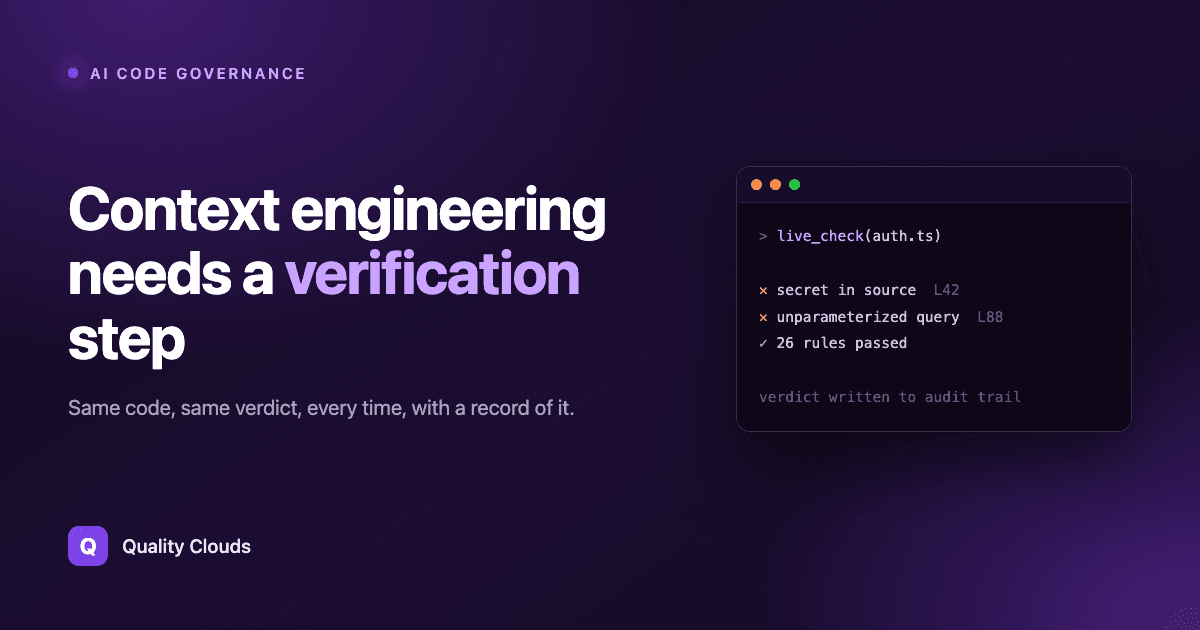
Context engineering needs a verification step
Albert Franquesa
5 min read
Better context raises the odds that AI-generated code is good. It does not tell you whether any particular file is. Here is where the check goes.

Claudeforce makes Salesforce headless. Governance has to move with it

Taher Dohadwala
6 min read
Salesforce is going headless. Learn what changes and how to govern what the agents build

Agentforce Vibes Governance: What Salesforce's New AI Coding Guardrails Mean for Your Org
Taher Dohadwala
7 min read
Salesforce is putting coding agent guardrails in DevOps Center. What the 6 policies cover, what they miss, and what to do about it.