Governance is not the opposite of speed
There is a version of AI Code Governance that sounds like a brake pedal — something applied after the interesting work is done, to slow things down before a release. That version is wrong. The right framing is the opposite: governance is what makes it safe to actually ship, whether you are a global enterprise pushing a platform update or a team of volunteers building public-interest software over a weekend.
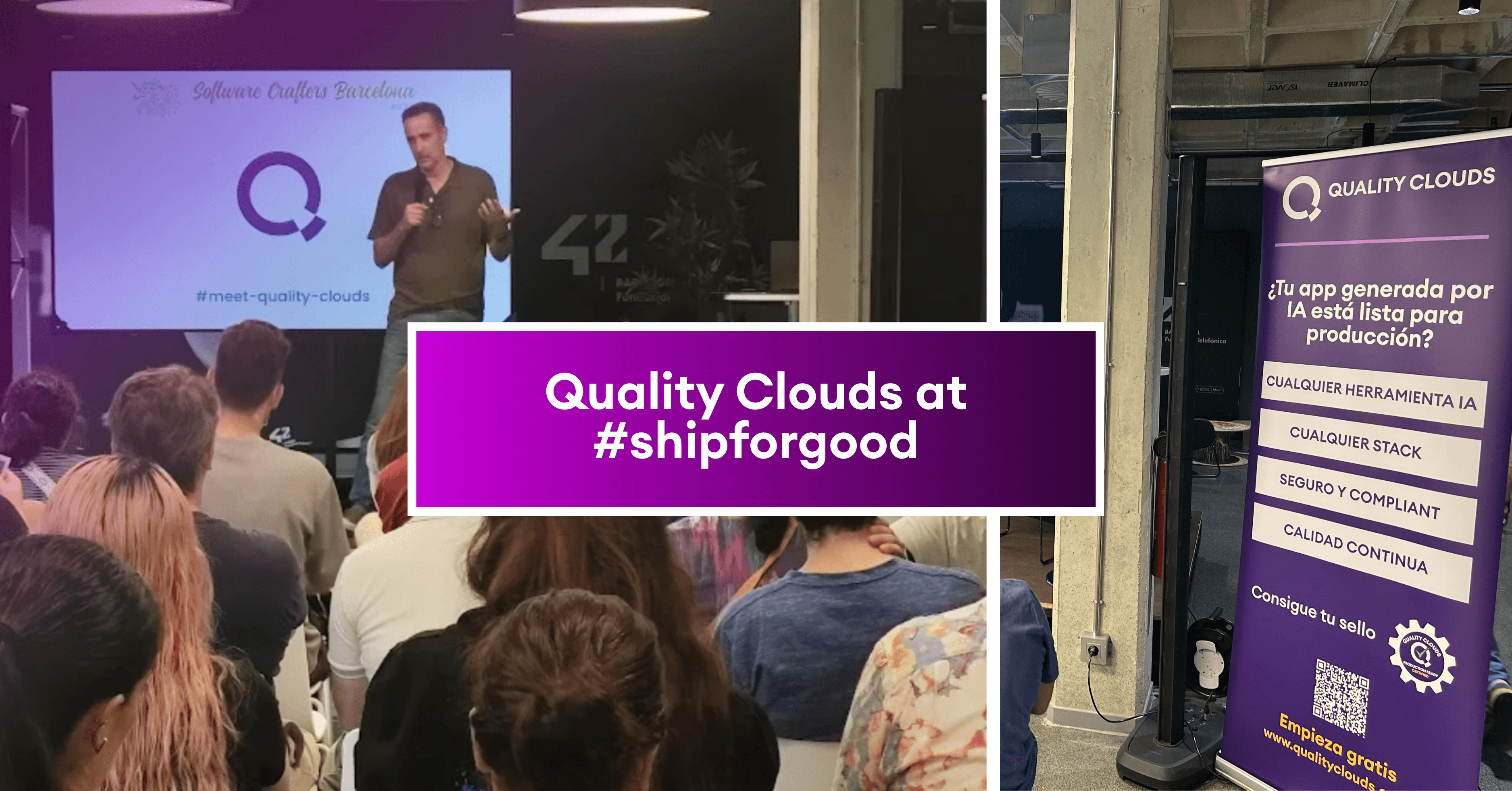
That is precisely why Quality Clouds showed up as a sponsor of Ship For Good — 1st Edition, a social-impact hackathon held on 29 and 30 May 2026 at 42 Barcelona. The event was organised by Software Crafters Barcelona, Fundación Civio and 42 Barcelona. The other sponsors were Manfred, Plain Concepts and Next Digital, with Lovable and Cursor also supporting the event.
No prize pool. No pitch competition. Developers, data professionals, product managers and designers building real solutions for a cause that demands intellectual honesty: Fundación Civio, an independent foundation that monitors public power and fights institutional opacity through journalism, technology and open data.
The alignment was clear. Quality Clouds exists to make AI-generated and AI-assisted code production-ready. Civio exists to make public institutions legible and accountable. Both organisations believe that what happens under the surface — in code, in data, in public procurement records — matters more than the surface itself.
What Ship For Good set out to do
Fundación Civio’s work is technically ambitious. The foundation maintains open datasets, builds investigative tools and publishes journalism that exposes how public money moves. The challenges it brought to Ship For Good were real operational problems, not contrived exercises.
The participants who spent the weekend at 42 Barcelona were practitioners — people who work in software and data professionally and chose to direct that expertise toward something with no commercial return. That motivation produces focused, purposeful work. It also produces AI-assisted code at pace. With tools like Cursor and Lovable available on-site, teams were generating, iterating and assembling code quickly. That speed is exactly where AI Code Governance becomes relevant.
The Talk on Saturday Morning
Quality Clouds’ co-founder, Albert Franquesa, gave a talk to open the technical programme. The question he addressed was direct: what does code quality actually mean when you are building fast, with AI assistance, for a cause rather than a product roadmap?
The answer Quality Clouds has developed over years of working with enterprise platforms is that quality is not a checklist applied at the end. It is a set of measurable properties — Security, Performance, Scalability, Maintainability, Architecture — that a codebase either has or does not have, and that you can assess at any stage. The earlier you assess, the cheaper it is to act on what you find.
For hackathon teams, that framing lands differently than it does in an enterprise context. There is no legacy debt, no deferred remediation backlog. There is a working prototype and a single question: is this something that could actually be deployed and trusted? The Production-Ready Score answers that question with evidence rather than opinion.
Saturday: Full Scans on what the teams built
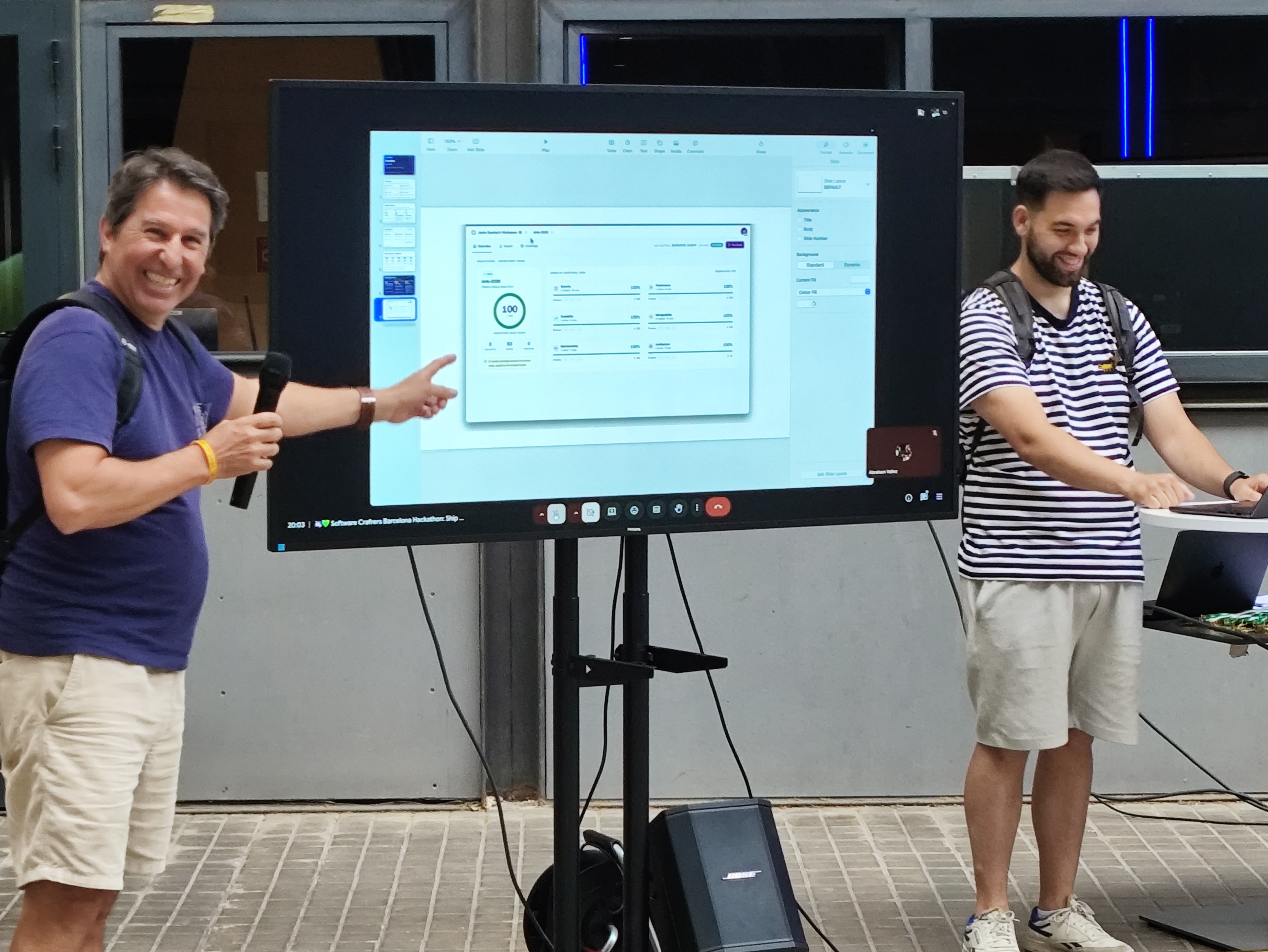
On Saturday 30 May, Quality Clouds made Norma by Quality Clouds available to the participating teams. Any team that wanted to could run a Full Scan on the code they had built and receive a Production-Ready Score.
The Full Scan assesses a codebase across five functional areas: Security, Performance, Scalability, Maintainability and Architecture. Each area produces a score, and those scores combine into an overall Production-Ready Score reflecting how close the code is to being deployable with confidence. The scan identifies specific findings — concrete issues mapped to the relevant part of the code — that a developer can act on immediately.
After applying some fixes in the code, the results were striking. Several teams recorded scores in the 90s. At least one team reached a perfect score of 100 across a functional area. For code built in under 36 hours, largely with AI assistance, those numbers reflect something real: when developers who care about their craft use AI tooling with intention, the output can be genuinely solid.
The Production-Ready Score is not designed to produce high numbers — it is designed to produce accurate ones. A score in the 90s reflects that the code meets a measurable standard across the dimensions that determine whether something can be trusted in a live environment.
What this says about AI-assisted development
Ship For Good was different in kind from the enterprise contexts where Quality Clouds typically operates, but not different in principle. The teams were building new code from scratch, fast, with AI tools. The question — can this be trusted? — is the same question enterprises ask before every deployment. The mechanism for answering it is the same: a structured assessment across the properties that determine production-readiness.
A Civio tool that reaches journalists, researchers or members of the public deserves the same scrutiny as an enterprise deployment. The stakes are different, but the principle is identical. Speed and quality are not inherently in tension when developers have clear feedback mechanisms. The Full Scan converts assumption into evidence — a structured, documented view of where the code actually stands.
Sponsoring events that reflect what we believe
Quality Clouds chooses its sponsorships based on alignment of values, not visibility. Ship For Good — 1st Edition aligned on every dimension that matters.
The event was organised by Software Crafters Barcelona, a community of practitioners who think carefully about how software is built. It was co-organised by Fundación Civio, whose work depends on technical rigour and public trust. It was hosted at 42 Barcelona. The other sponsors — Manfred, Plain Concepts and Next Digital — are organisations with real substance. Lovable and Cursor are among the tools defining how AI-assisted development is done today.
For Quality Clouds, the weekend was also a demonstration of what AI Code Governance looks like in practice outside an enterprise context. When teams ran the Full Scan on Saturday, they were using a tool to understand their own code better. That is the experience we want every developer to have: the clarity that comes from knowing, rather than assuming, that what you have built is Production-Ready AI Code.
Build with AI. Ship with confidence
Connect your Git repo in minutes. Enforce real-time AI governance, run full codebase scans, and apply instant auto-fixes via MCP directly inside your editor
Frequently Asked Questions
What is AI Code Governance and why does it matter for rapid development?
AI Code Governance is the discipline of assessing, validating and enforcing quality standards on code that has been generated or assisted by AI tools. It matters for rapid development because AI tools increase the speed at which code is produced, which increases the rate at which unreviewed or structurally weak code can accumulate. Without a governance layer, speed creates risk. Quality Clouds provides AI Code Governance as a structured assessment across Security, Performance, Scalability, Maintainability and Architecture — giving teams an evidenced view of where their code stands at any point in development.
What is the Production-Ready Score and how is it calculated?
The Production-Ready Score is produced by the Quality Clouds Full Scan. It reflects how close a codebase is to being deployable with confidence. It is derived from assessments across five functional areas: Security, Performance, Scalability, Maintainability and Architecture. Each area is scored individually based on findings detected in the code, and those scores combine into the overall result. The score is designed to be accurate rather than generous — a high score reflects that the code genuinely meets measurable standards across the dimensions that matter in a production environment.
How does AI Code Governance relate to regulations such as the EU AI Act or DORA?
Both the EU AI Act and DORA (the Digital Operational Resilience Act) impose obligations that require organisations to demonstrate control over the software systems they operate. The EU AI Act requires transparency and robustness for high-risk AI systems. DORA requires financial entities to maintain ICT risk management frameworks covering the integrity and security of their systems. AI Code Governance supports compliance with both by providing documented, repeatable assessments of the code entering production environments. Quality Clouds Full Scans produce audit-ready evidence of code quality across functional areas.
How does Quality Clouds compare to security-focused scanning tools?
Security scanners focus on identifying vulnerabilities in code and dependencies. Quality Clouds addresses a broader scope: AI Code Governance across Security, Performance, Scalability, Maintainability and Architecture. Security is one of five dimensions in a Full Scan, alongside structural and architectural properties that determine how a codebase behaves under load, how it scales and how it can be maintained over time. For teams that need a complete view of production-readiness rather than a security-specific report, Quality Clouds provides coverage that extends beyond the vulnerability surface.
Can Norma by Quality Clouds be used outside enterprise platform contexts?
Yes. Ship For Good — 1st Edition demonstrated this directly. Teams building new codebases from scratch over 36 hours used Norma to run Full Scans and receive Production-Ready Scores on their work. The platform is designed for any codebase that needs to be understood and trusted — whether it sits inside a large enterprise platform or has been assembled by a small team for a public-interest project. The same assessment criteria apply, because the properties that make code production-ready are consistent regardless of context.
What is AI Code Governance and why does it matter for rapid development?
AI Code Governance is the discipline of assessing, validating and enforcing quality standards on code that has been generated or assisted by AI tools. It matters for rapid development because AI tools increase the speed at which code is produced, which increases the rate at which unreviewed or structurally weak code can accumulate. Without a governance layer, speed creates risk. Quality Clouds provides AI Code Governance as a structured assessment across Security, Performance, Scalability, Maintainability and Architecture — giving teams an evidenced view of where their code stands at any point in development.
What is the Production-Ready Score and how is it calculated?
The Production-Ready Score is produced by the Quality Clouds Full Scan. It reflects how close a codebase is to being deployable with confidence. It is derived from assessments across five functional areas: Security, Performance, Scalability, Maintainability and Architecture. Each area is scored individually based on findings detected in the code, and those scores combine into the overall result. The score is designed to be accurate rather than generous — a high score reflects that the code genuinely meets measurable standards across the dimensions that matter in a production environment.
How does AI Code Governance relate to regulations such as the EU AI Act or DORA?
Both the EU AI Act and DORA (the Digital Operational Resilience Act) impose obligations that require organisations to demonstrate control over the software systems they operate. The EU AI Act requires transparency and robustness for high-risk AI systems. DORA requires financial entities to maintain ICT risk management frameworks covering the integrity and security of their systems. AI Code Governance supports compliance with both by providing documented, repeatable assessments of the code entering production environments. Quality Clouds Full Scans produce audit-ready evidence of code quality across functional areas.
How does Quality Clouds compare to security-focused scanning tools?
Security scanners focus on identifying vulnerabilities in code and dependencies. Quality Clouds addresses a broader scope: AI Code Governance across Security, Performance, Scalability, Maintainability and Architecture. Security is one of five dimensions in a Full Scan, alongside structural and architectural properties that determine how a codebase behaves under load, how it scales and how it can be maintained over time. For teams that need a complete view of production-readiness rather than a security-specific report, Quality Clouds provides coverage that extends beyond the vulnerability surface.
Can Norma by Quality Clouds be used outside enterprise platform contexts?
Yes. Ship For Good — 1st Edition demonstrated this directly. Teams building new codebases from scratch over 36 hours used Norma to run Full Scans and receive Production-Ready Scores on their work. The platform is designed for any codebase that needs to be understood and trusted — whether it sits inside a large enterprise platform or has been assembled by a small team for a public-interest project. The same assessment criteria apply, because the properties that make code production-ready are consistent regardless of context.
What is AI Code Governance and why does it matter for rapid development?
AI Code Governance is the discipline of assessing, validating and enforcing quality standards on code that has been generated or assisted by AI tools. It matters for rapid development because AI tools increase the speed at which code is produced, which increases the rate at which unreviewed or structurally weak code can accumulate. Without a governance layer, speed creates risk. Quality Clouds provides AI Code Governance as a structured assessment across Security, Performance, Scalability, Maintainability and Architecture — giving teams an evidenced view of where their code stands at any point in development.
What is the Production-Ready Score and how is it calculated?
The Production-Ready Score is produced by the Quality Clouds Full Scan. It reflects how close a codebase is to being deployable with confidence. It is derived from assessments across five functional areas: Security, Performance, Scalability, Maintainability and Architecture. Each area is scored individually based on findings detected in the code, and those scores combine into the overall result. The score is designed to be accurate rather than generous — a high score reflects that the code genuinely meets measurable standards across the dimensions that matter in a production environment.
How does AI Code Governance relate to regulations such as the EU AI Act or DORA?
Both the EU AI Act and DORA (the Digital Operational Resilience Act) impose obligations that require organisations to demonstrate control over the software systems they operate. The EU AI Act requires transparency and robustness for high-risk AI systems. DORA requires financial entities to maintain ICT risk management frameworks covering the integrity and security of their systems. AI Code Governance supports compliance with both by providing documented, repeatable assessments of the code entering production environments. Quality Clouds Full Scans produce audit-ready evidence of code quality across functional areas.
How does Quality Clouds compare to security-focused scanning tools?
Security scanners focus on identifying vulnerabilities in code and dependencies. Quality Clouds addresses a broader scope: AI Code Governance across Security, Performance, Scalability, Maintainability and Architecture. Security is one of five dimensions in a Full Scan, alongside structural and architectural properties that determine how a codebase behaves under load, how it scales and how it can be maintained over time. For teams that need a complete view of production-readiness rather than a security-specific report, Quality Clouds provides coverage that extends beyond the vulnerability surface.
Can Norma by Quality Clouds be used outside enterprise platform contexts?
Yes. Ship For Good — 1st Edition demonstrated this directly. Teams building new codebases from scratch over 36 hours used Norma to run Full Scans and receive Production-Ready Scores on their work. The platform is designed for any codebase that needs to be understood and trusted — whether it sits inside a large enterprise platform or has been assembled by a small team for a public-interest project. The same assessment criteria apply, because the properties that make code production-ready are consistent regardless of context.