
An analysis of Satya Nadella’s latest framework on human vs. token capital, and how AI Code Governance secures your organization’s proprietary knowledge


The Most Important Thing Satya Nadella Said This Week
Microsoft Chairman and CEO Satya Nadella published a statement this week that enterprise leaders should read carefully. The message was not about a new product launch or quarterly numbers. It was a structural warning about which companies will retain their value — and which will not — as AI reshapes how work gets done.
The argument: picking the best AI model is not enough. The companies that survive the AI era will be those that build a proprietary learning loop on top of those models — one that compounds both human expertise and AI capability over time. This is precisely the challenge that AI Code Governance is designed to address for enterprises running mission-critical software platforms.
Human Capital and Token Capital: Nadella's Framework
Nadella introduced two concepts that belong at the top of every enterprise architecture review: human capital and token capital. Human capital covers what employees bring to the organisation — expertise, judgement, domain knowledge, relationships, and pattern recognition built from years of practice. Token capital refers to the AI capabilities a company builds and owns: the systems, models, and agentic workflows trained on its own data and processes.
Most enterprises are focused on the wrong problem. They are evaluating models, comparing vendors, and running pilots. Nadella's point is that none of that creates durable competitive advantage on its own. "The real opportunity is not in picking the best model," he wrote, "but instead in building a learning loop on top of models where human capital and token capital compound." He identified a company's real intellectual property in the AI era as not its raw data, but the proprietary learning system built from its workflows, domain expertise, and accumulated judgement.
The Risk: A Repeat of the Outsourcing Era
Nadella's warning carries historical weight. He drew a direct parallel between the current moment and the first phase of globalisation, when outsourcing improved headline economic indicators while hollowing out industrial ecosystems. His concern with AI follows the same logic. Organisations across every sector risk ceding value to a few models that "eat everything they see." "If all the value is accrued by only a few models," he said, "the political economy will simply not tolerate it."
For enterprise CTOs and CISOs, this translates into a concrete architectural question: is your AI investment building something your organisation owns, or are you simply paying for access to capabilities that belong to someone else?
Agentic Systems as the Practical Answer
Nadella's prescription is specific. Companies should build agentic systems that retain and improve institutional knowledge over time, while remaining flexible enough to swap underlying foundation models as technology changes. The model is the engine. The company's knowledge — its workflows, decisions, best practices, and domain expertise — is the fuel and navigation system. "Without human direction," he wrote, "you have compute running in circles."
This matters enormously for enterprises running ERPs platforms. When AI development tools — whether GitHub Copilot, Cursor, Replit, Claude Code, or Lovable — generate code for these platforms, that output must adhere to platform-specific standards, security requirements, and architectural constraints. Without a governance layer that encodes an organisation's accumulated platform expertise, every AI-generated customisation risks eroding rather than compounding that expertise.
Where AI Code Governance Enters the Picture
This is the gap that AI Code Governance fills. For enterprise software platforms, the learning loop runs through code: the customisations, workflows, integrations, and business logic that encode how an organisation actually operates.
Quality Clouds provides the AI Code Governance layer that makes this loop work in practice. When AI development tools generate code, Quality Clouds enforces the organisation's specific standards — security policies, architectural rules, compliance requirements, and platform best practices — automatically and at every stage of delivery.
LivecheckAI applies this governance in real time, flagging violations before issues reach production. The AI Rule Builder allows organisations to codify institutional knowledge — the accumulated judgement of their platform architects — into enforceable rules that govern both human-written and AI-generated code alike. Quality Gates and Full Scan establish systematic checkpoints that prevent non-compliant code from advancing through the delivery pipeline.
Nadella's framework maps directly to this architecture. LivecheckAI and Quality Gates ensure that token capital — the AI-generated code produced at scale — is held to the standards human capital has established. The AI Rule Builder is how that human capital gets encoded so it can scale without degrading. Without this governance layer, enterprises do not build a learning loop. They build technical debt at AI speed.
WHITEPAPER
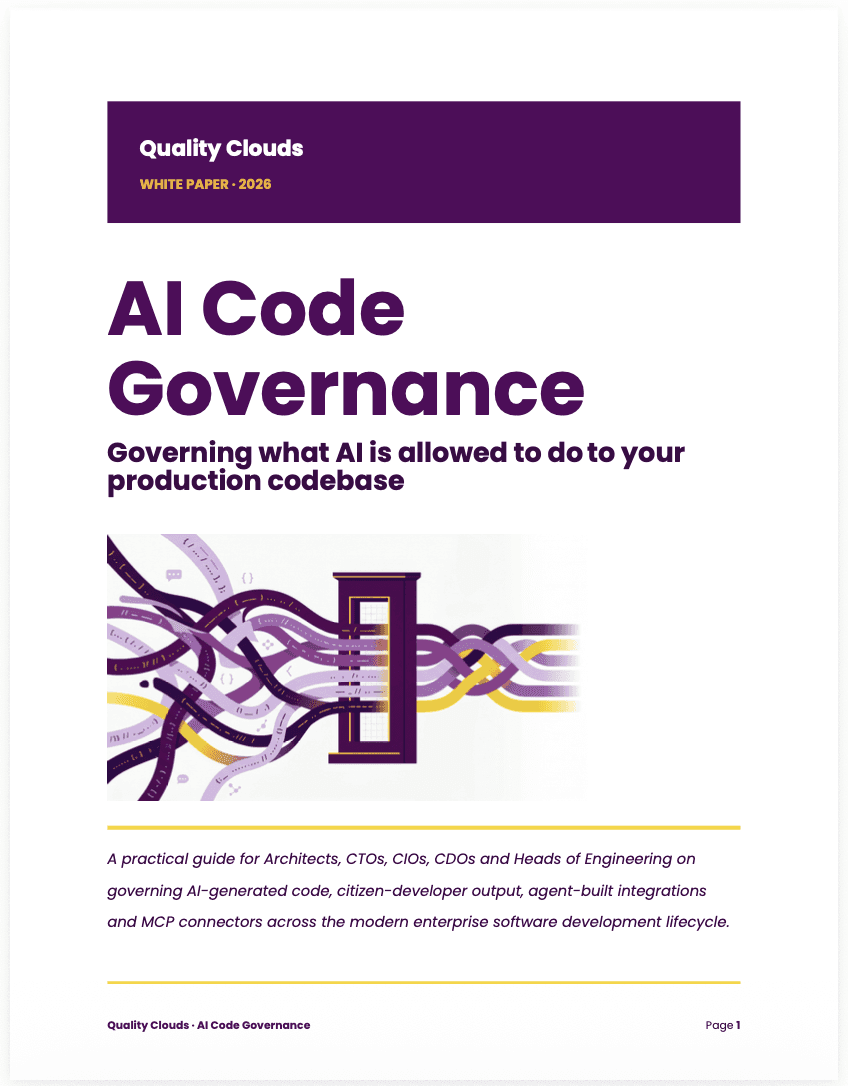
The Enterprise Guide to AI Code Governance
Learn how to turn AI-generated code into a proprietary asset that compounds your institutional knowledge
The Governance Gap Enterprises Must Close
According to Deloitte's 2026 State of AI in the Enterprise report, only one in five companies has a mature model for governance of autonomous AI agents. Organisations are deploying AI across development tools, agentic workflows, and platform customisations — without the governance infrastructure to ensure that deployment builds lasting, owned value.
Regulatory pressure reinforces the business case. The EU AI Act, DORA, and sector-specific guidance from the FCA require enterprises to demonstrate accountability for AI-influenced decisions and AI-generated system changes. That accountability comes from systematic, auditable governance applied to every output AI systems produce — including the code those systems write.
The Frontier Ecosystem Requires Governance
Nadella called for a "frontier ecosystem" where value is distributed broadly across businesses and industries, rather than concentrated in a few model providers. For that ecosystem to function, organisations need the infrastructure to own and compound their learning loop. Human expertise must be codified into enforceable standards. AI-generated outputs must be validated before they reach production. Platform-specific knowledge must be applied automatically, across every tool, every developer, and every deployment cycle.
Quality Clouds makes this possible across the software stacks where enterprise AI development is accelerating fastest: AI development tools — from GitHub Copilot to Claude Code — that teams use to build on top of them. For any software stack, any AI development tool, and any enterprise, AI Code Governance is the layer that converts AI activity into owned, compounding value. That is what it means to deliver Production-Ready AI Code.
Stop renting AI capabilities. Own your logic.
Connect your repository to protect your IP in real time
Frequently Asked Questions

Albert Franquesa
Co-Founder & CSO, Quality Clouds
Related articles
Stay ahead of the curve

Claudeforce makes Salesforce headless. Governance has to move with it

Taher Dohadwala
6 min read
Salesforce is going headless. Learn what changes and how to govern what the agents build

Your Vibe Coded App Probably Has a Security Hole. Here Is How to Find It.
Albert Franquesa
10 min read
The five security holes AI keeps writing into vibe coded apps, and how to find yours in about two hours.

Agentforce Vibes Governance: What Salesforce's New AI Coding Guardrails Mean for Your Org
Taher Dohadwala
7 min read
Salesforce is putting coding agent guardrails in DevOps Center. What the 6 policies cover, what they miss, and what to do about it.